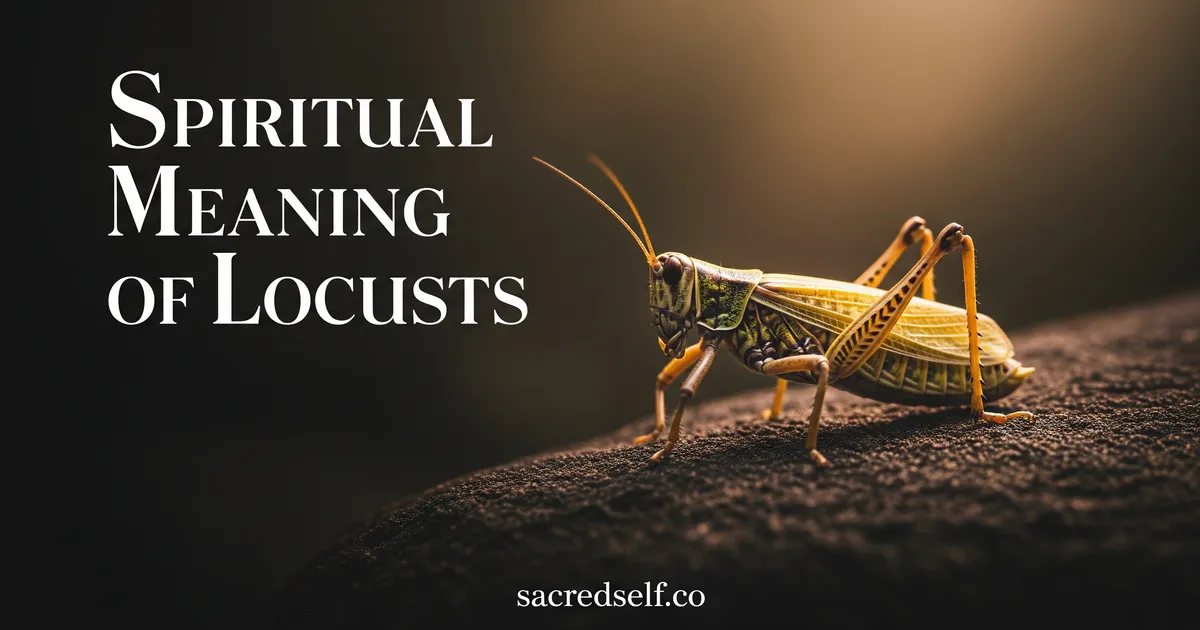
In the Bible, locusts devastated Egypt’s crops in a single night. In dreams, they swarm and devour. In nature, they transform from solitary creatures into unstoppable collective forces. Few symbols carry this much weight across so many traditions – and few creatures demand attention quite like locusts do.
If you’ve encountered one, you already know: there’s nothing subtle about it. The sound alone is impossible to ignore. Whether you saw a single locust or witnessed a swarm, the experience likely stirred something – curiosity, unease, or the sense that you’re in the middle of something bigger than you realized.
Key Takeaways
- Locusts symbolize transformation through disruption – major shifts that feel unavoidable and often uncomfortable
- They represent cycles of abundance and scarcity, reminding us that both are natural and temporary
- In biblical contexts, locusts signal warning, consequence, and the possibility of renewal after hardship
- Encountering a locust often points to something building in your life that needs attention before it becomes overwhelming
- Dreams about locusts typically reflect feelings of being invaded, losing control, or facing resource depletion
- Context matters: a single locust feels like an early signal, while a swarm represents collective force or being swept up in something larger
- Your emotional response and current life circumstances shape the meaning more than any fixed interpretation
✨ Check current prices on Amazon: Best Palo Santo Burner
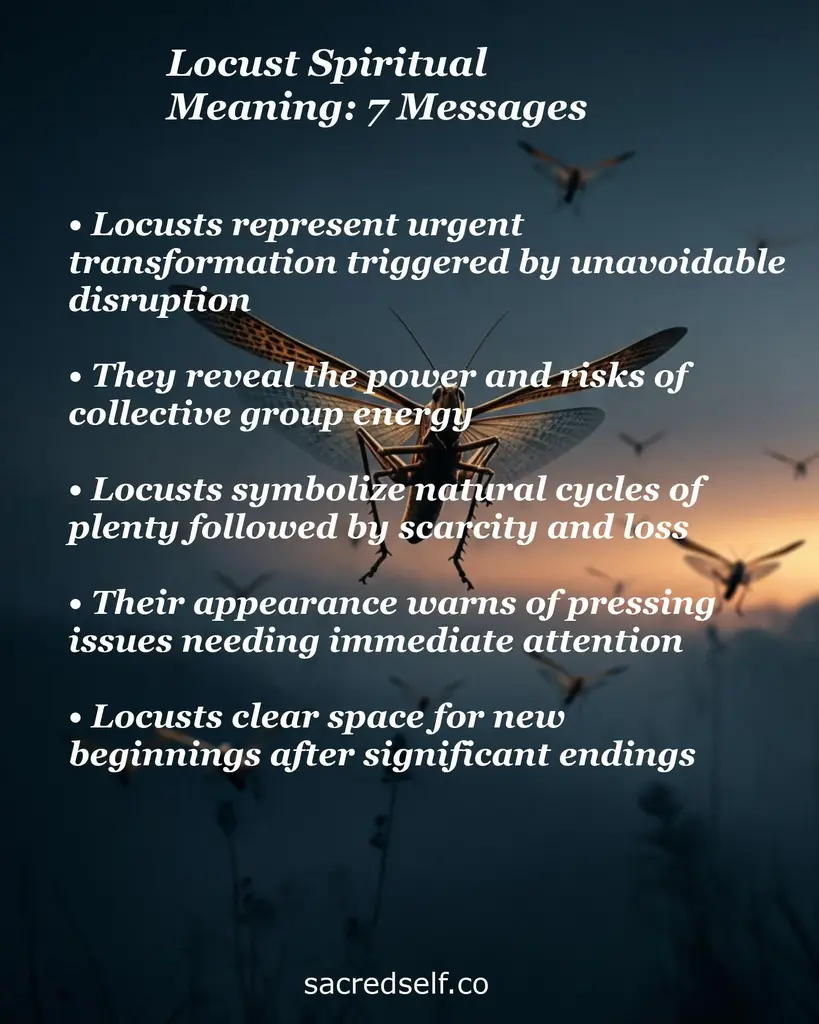
7 Spiritual Meanings of Locusts
1. Transformation Through Disruption
Locusts undergo one of nature’s most dramatic transformations. Alone, they’re harmless grasshoppers. Together, triggered by environmental pressure, they shift into swarming phase – different color, different behavior, unstoppable momentum.
This isn’t gradual change. It’s sudden, unavoidable, and often triggered by circumstances beyond individual control.
When this applies: You’re in a period of forced change. Something in your life is shifting whether you’re ready or not – job loss, relationship ending, health crisis, or internal awakening you can’t ignore anymore.
Reflection: What in your life is changing despite your resistance? How might you work with this shift instead of fighting it?
Practical step: Identify one small area where you can take intentional action within the larger upheaval. You can’t control the storm, but you can adjust your response.
2. Collective Energy and Group Dynamics
A single locust is manageable. A swarm is a force of nature. The difference is collective energy – individual creatures moving as one unstoppable mass.
This symbolizes the power and danger of group dynamics. Movements, family patterns, workplace culture, social pressure – the energy of many can create or destroy.
When this applies: You’re navigating group dynamics at work, feeling swept up in family patterns, caught in social movements, or noticing how collective emotion affects your decisions.
Reflection: Are you moving with a group right now? Is that alignment healthy or just momentum? Does it reflect your values or drain your energy?
Practical step: Check in on your current commitments. Which ones genuinely align with who you are, and which are you doing because everyone else is?
3. Abundance and Scarcity – Both Sides of the Cycle
Here’s the paradox: locusts appear during times of abundant growth. That’s what they eat. But what they leave behind is scarcity – stripped fields, bare ground, loss.
They don’t symbolize one or the other. They symbolize the cycle itself. Plenty and lack are two phases of the same natural rhythm.
When this applies: You’re experiencing financial shifts, resource anxiety, or the awareness that loss often precedes new growth. You’re learning that scarcity isn’t permanent and neither is abundance.
Reflection: Where are you experiencing scarcity right now? What might be trying to grow back in the cleared space?
Practical step: Take stock of your resources – time, money, energy, relationships. Don’t judge. Just observe where you are in the cycle.
4. Warning or Wake-Up Call
Across cultures and traditions, locusts appear as messengers – not to punish, but to warn: something needs attention now, before it becomes overwhelming.
This isn’t about fear. It’s about awareness. What’s been building quietly that you’ve been avoiding? What small problem is multiplying?
When this applies: Persistent small issues you keep dismissing. Ignored intuition. Patterns you’ve been rationalizing away. The feeling that something’s “off” but you haven’t named it yet.
Reflection: What have you been putting off addressing? What would it look like to respond now instead of waiting until it’s a crisis?
Practical step: Name one thing that’s been nagging at you. Take the smallest possible action toward it this week – one email, one conversation, one decision.
5. Cleansing and Starting Over
In some spiritual contexts, locusts strip everything back to bare ground. It’s painful. It’s devastating. And it’s also a clean slate.
After locusts, there’s nowhere to go but rebuild. Nothing left to cling to. Only the possibility of starting fresh.
When this applies: You’ve experienced loss – relationship ending, career change, health crisis, identity shift. You feel like you’re starting from scratch, and it’s terrifying and freeing at the same time.
Reflection: What needs to be cleared away before something new can grow? What are you holding onto that’s already gone?
Practical step: Identify one habit, commitment, or mindset you’re ready to release. Write it down and declare it done.
6. Survival Instinct and Adaptability
Locusts are survivors. They adapt to harsh conditions, travel thousands of miles, endure scarcity, and keep going. As individuals and as swarms, they represent resilience.
This is your reminder: you have deeper reserves of strength than you realize.
When this applies: You’re being tested. Facing scarcity, enduring hardship, or feeling stretched beyond your limits. You need to tap into survival mode and trust your ability to adapt.
Reflection: Where have you already proven your adaptability? What challenges have you navigated that you’re not giving yourself credit for?
Practical step: Write down three difficult things you’ve survived. Remind yourself you’ve done hard things before – and you can do them again.
7. Sound and Presence – Impossible to Ignore
Locusts are loud. Visually overwhelming. They demand attention through sheer presence. You can’t tune them out.
Symbolically, this represents something in your life – internal or external – that refuses to be ignored anymore.
When this applies: Persistent emotions you keep pushing down. Truths you’ve been avoiding. Situations that keep showing up no matter how many times you dismiss them.
Reflection: What keeps showing up in your thoughts, conversations, or environment? What is it asking you to face?
Practical step: Spend 10 minutes journaling on what’s been loudest in your mind lately. Don’t try to solve it. Just acknowledge it.
Cultural and Spiritual Perspectives on Locusts
Locusts appear across spiritual traditions, each offering a different lens on their meaning. Understanding these perspectives adds depth to your own interpretation.
Biblical and Judeo-Christian Symbolism
Locusts appear prominently throughout the Bible, often as instruments of divine consequence and catalysts for change.
In Exodus 10:1-20, locusts are the eighth plague sent to Egypt – devastating crops and forcing Pharaoh to confront his refusal to release the Israelites. They represent divine intervention, the consequences of oppression, and the power to bring systems to their knees.
In the Book of Joel (chapters 1-2), locusts symbolize both devastation and hope. They strip the land bare as judgment for spiritual neglect, but Joel also promises restoration: “I will restore to you the years that the swarming locust has eaten” (Joel 2:25). The message: even after complete loss, renewal is possible.
John the Baptist ate locusts and wild honey in the wilderness (Matthew 3:4) – a symbol of simplicity, survival, and spiritual preparation. It represents stripping away excess and relying on what’s essential.
In Revelation 9, locusts take on apocalyptic symbolism – agents of judgment with the power to torment but not kill. This is highly symbolic literature emphasizing spiritual consequence and the reality of facing what’s been avoided.
Overall biblical theme: Locusts represent consequence, warning, and the clearing away of what no longer serves – but also the promise of restoration after hardship.
Locusts vs. Grasshoppers in Spiritual Context
Biologically, locusts are grasshoppers that enter a swarming phase when environmental conditions trigger hormonal and behavioral changes. Same species, different state.
Spiritually, the distinction matters.
Grasshoppers symbolize patience, intuition, taking leaps of faith, and trusting your instincts. The energy is solitary, observant, personal.
Locusts carry intensity – collective force, urgency, transformation through disruption, and the power of many moving as one. The energy is overwhelming, unavoidable, transformative.
If your encounter felt calm and observant, grasshopper symbolism may resonate more. If it felt loud, urgent, or like something you couldn’t ignore, locust energy applies.
🦋 Others who searched this also read: Black Cricket Spiritual Meanings
Locust Encounters in Different Contexts
The meaning of a locust encounter shifts dramatically based on how and where you experienced it. Context is everything.
Seeing a Single Locust
A single locust is less about overwhelming change and more about noticing early warning signals.
It’s the early warning signal before larger change. The pattern beginning to form. The individual call to adapt before circumstances force you to.
Reflection: What small change is beginning in your life? What are you noticing that others might miss? What would it look like to respond now?
Encountering a Swarm
A swarm amplifies every theme – collective energy, being overwhelmed, facing something much larger than yourself.
It can feel terrifying. It can also feel awe-inspiring. Both responses are valid. The key is recognizing when you’re swept up in forces beyond individual control.
Reflection: Where do you feel outnumbered or swept up right now? Is there a way to find your footing within the chaos, or do you need to step back entirely?
Dead Locust
A dead locust symbolizes the ending of a cycle. Release from pressure. Evidence that a difficult period has passed.
It can represent relief, the aftermath of transformation, or the need to integrate what you’ve survived before moving forward.
Reflection: What chapter is closing in your life? What did you survive that you can now learn from? What do you need to process before you’re ready to move on?
Brown Locust
Brown connects to earth, grounding, and the natural cycle of growth and decay. A brown locust emphasizes the physical, practical side of change.
This isn’t abstract spiritual transformation. It’s material concerns – money, home, body, work, tangible shifts in your environment.
Reflection: How is change showing up in your physical world right now? What practical adjustments do you need to make? Where do you need to stay grounded while everything shifts?
Spiritual Meaning of Locusts in Dreams
Dreams about locusts aren’t predictive. They’re your subconscious processing feelings of overwhelm, loss, or transition.
Common dream scenarios include:
- Swarm approaching or surrounding you: Anxiety about upcoming challenges, feeling outnumbered, or losing control. Your mind is processing something that feels unavoidable.
- Locusts destroying crops or your home: Fear of loss, scarcity, or something valuable being taken away. This often reflects resource anxiety or the sense that what you’ve built is under threat.
- Watching locusts from a distance: Observing patterns in your life, awareness of collective issues, or processing change from a safer vantage point. You see it coming but haven’t been directly impacted yet.
- Killing or escaping locusts: Attempting to regain control, set boundaries, or protect what matters to you. This reflects your desire to take action against overwhelm.
Reflection: What felt out of control in the dream? Where does that echo in your waking life? What is your subconscious trying to process?
Practical step: Write down the dream details and your emotional response. Look for parallels to current stressors, relationships, or situations where you feel invaded or overwhelmed.
🦋 You might also enjoy reading about: Spiritual Meaning Of A Caterpillar
Locust as a Spirit Animal or Totem
Some people resonate deeply with locust energy – not just in a single encounter, but as an ongoing spiritual guide.
What It Means If Locust Is Your Spirit Animal
You naturally understand cycles of abundance and scarcity without panic. You know both are temporary.
You’re comfortable with transformation, even when it’s disruptive or uncomfortable. You don’t resist change – you adapt and keep moving.
You’re attuned to group dynamics and collective energy. You understand when to move with others and when to stand apart. You recognize the power and danger of swarms.
You’re resilient in the face of hardship. You’ve been tested and survived. You trust your ability to endure.
When Locust Appears as a Guide
Locust may show up during times of major transition, resource shifts, or when you need to tap into survival instincts.
It reminds you that disruption can clear the way for new growth. What feels like loss might be making space for something better.
It encourages you to pay attention to what’s building, adapt quickly, and trust your ability to endure.
Working With Locust Energy
Practice: Notice where you resist change versus where you can flow with it. Where are you clinging? Where are you adapting?
Ask yourself: What needs to be cleared? What am I building resilience around? Where am I being called to transform?
Honor both sides: Locusts represent destruction and renewal. They’re part of the same cycle. You can’t have one without the other.
What Should You Do After a Locust Encounter?
If you’ve encountered a locust and it felt meaningful, here’s how to make sense of it.
Pause and notice your immediate reaction: Were you startled, curious, overwhelmed, calm? Your emotional response is information.
Consider the context: Where were you? What were you thinking about before the encounter? Timing and setting often reveal relevance.
Ask reflective questions:
- What in my life feels like it’s swarming or building?
- Where am I being asked to adapt or let go?
- Am I avoiding something that keeps showing up?
- What cycle am I in – abundance, scarcity, or transition between the two?
Take one small action: If the encounter feels like a wake-up call, respond with something tangible. Don’t just think about it – do something.
Journal the experience: Write what you saw, felt, and wondered. Patterns often become clear over time.
Release the need for a single answer: Symbolism is personal. Trust what resonates and let the rest go.
Frequently Asked Questions
What does locust represent spiritually?
Locusts stand for transformation through disruption, cycles of abundance and scarcity, and the power of collective energy. Across traditions, they signal warning, consequence, and renewal. A single locust is an early alert; a swarm shows overwhelming force. Your personal circumstances and feelings shape the message.
What do locusts symbolize in the Bible?
In the Bible, locusts act as instruments of divine judgment and catalysts for change. In Exodus 10, they’re the eighth plague against Egypt’s crops, pushing Pharaoh to release the Israelites. The Book of Joel ties locusts to devastation and also restoration: “I will restore to you the years that the swarming locust has eaten.” John the Baptist’s diet of locusts (Matthew 3:4) highlights simplicity and spiritual readiness. Revelation 9 uses locusts as apocalyptic figures symbolizing spiritual trials.
What demon is associated with locust?
Revelation 9:11 describes locusts ruled by an angel named Abaddon (Hebrew) or Apollyon (Greek), meaning “Destroyer.” This is symbolic apocalyptic imagery emphasizing judgment. Beyond this, locusts are generally seen as natural forces or divine messengers, not demons.
What does it mean to dream about locusts?
Dreaming of locusts usually reflects feeling overwhelmed or invaded. Common dreams include swarms, destruction, watching from afar, or fighting locusts. These images show your mind processing stress or transition, not predicting the future. Write down the dream details and feelings, then connect them to challenges or pressures you face.
Is seeing a locust a bad omen?
Not always. Locusts often represent hardship but also transformation and resilience. A single locust may be a small alert; a swarm might highlight larger forces at work. Instead of labeling the experience good or bad, consider what it points to in your life and what needs your focus.
What’s the difference between locust and grasshopper symbolism?
Locusts are grasshoppers that change behavior under certain conditions. Spiritually, grasshoppers symbolize patience, intuition, and faith – solitary and reflective energy. Locusts bring urgency, collective force, and intense disruption. If your encounter felt calm and personal, grasshopper meanings fit better; if loud and overwhelming, locust energy applies.
What does a brown locust mean spiritually?
Brown connects to the earth, grounding, and the cycle of growth and decay. A brown locust emphasizes practical, physical aspects of change – money, home, body, work. It invites you to acknowledge how transformation affects your tangible surroundings and to stay grounded as you navigate disruption.
What does a dead locust symbolize?
A dead locust marks the end of a difficult cycle or release from pressure. It shows a period of upheaval has passed. This can mean relief and the need to integrate past experiences before moving on. Reflect on what chapter is closing and what you’ve learned from that phase.
Final Thoughts
Locusts show up when something significant is shifting – inside you, around you, or both. They arrive loud, impossible to ignore, forcing you to pay attention.
That’s the gift of disruption. Scarcity teaches you what matters. Sizable swarms remind you that collective energy is powerful – and you get to choose whether to move with it or step aside.
Whatever brought you here, trust your curiosity is part of making sense of the experience.
What are you noticing in your life right now that feels too big to ignore? What would it look like to meet that awareness with one small action?
If you’ve had your own locust encounter – in waking life or in a dream – share it in the comments. Sometimes naming the experience helps it settle.
Namaste. 🙏
🦋 Worth exploring next: Spiritual Meaning Of Seeing A Wolf