
Rachel died giving birth to him, naming him Benoni – son of sorrow. Jacob immediately renamed him Benjamin – son of the right hand. The same child, two names, two futures.
Benjamin appears consistently across traditions as representing favor, protection, and purposeful strength.
Key Takeaways
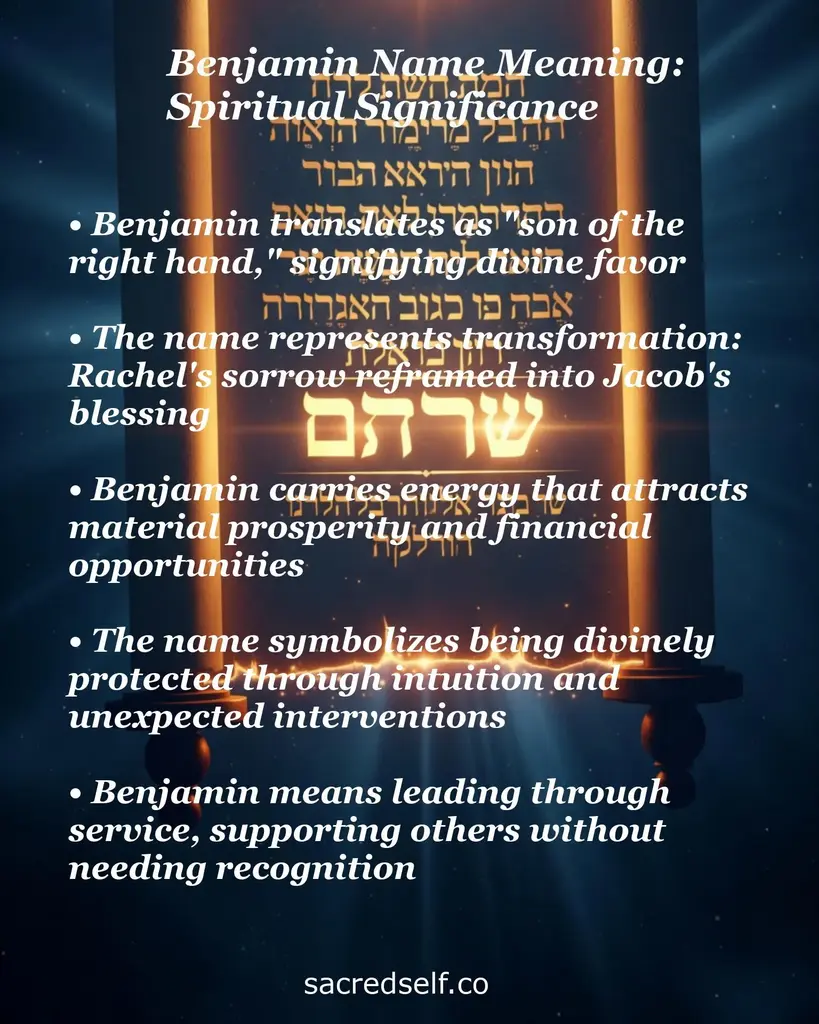
- Benjamin means ‘son of the right hand’ – a position of honor, power, and divine favor in biblical tradition
- Represents transformation from struggle to joy, moving from sorrow (Benoni) to blessing (Benjamin)
- Connected to prosperity and material blessing across spiritual traditions
- Symbolizes being protected and cherished, like Jacob’s special protection of his youngest son
- Associated with loyal leadership and service, leading without needing glory
- Carries bridge energy – connecting generations, perspectives, and worlds
7 Spiritual Meanings of the Name Benjamin
1. Divine Favor and Right-Hand Position
In biblical tradition, the right hand represents power and honor. Kings placed trusted advisors at their right hand. God’s right hand symbolizes salvation and strength.
Benjamin’s name claims this position – not through force, but as a gift. This represents favor that comes as blessing, not reward. The name suggests someone who experiences favor without seeking it, who finds doors opening that others must push.
This isn’t about entitlement. It’s about recognizing where grace shows up in your life. Where do opportunities appear with unusual ease? Where do people naturally trust or support you? This quality of Benjamin represents favor that comes as blessing, not reward.
2. Transformation from Sorrow to Joy
Rachel’s last breath named her son Benoni – son of my sorrow. Jacob rejected that identity and gave him Benjamin instead. Same child, completely different destiny.
Names shape how we see ourselves. The spiritual lesson here isn’t about denying pain – Rachel’s death was real, the grief legitimate. But Jacob refused to let tragedy define his son’s entire existence.
This transformation energy appears when you reframe difficult circumstances. Not pretending they didn’t happen, but choosing which story defines you going forward. Benjamin represents the possibility that what begins in sorrow can become a source of strength and blessing.
3. Prosperity and Material Blessing
Benjamin is consistently associated with abundance and financial favor in spiritual traditions. Joseph gave Benjamin five times more food than his brothers. The tribe of Benjamin received choice land.
This isn’t magical thinking – it’s a pattern of provision. The name carries energy that attracts resources and opportunities for material success.
The spiritual practice here is gratitude and responsible stewardship. If this resonates with you, prosperity may come more easily. The test is what you do with it. Do you hoard or share? Do you recognize blessing as gift or achievement?
4. Protection and Spiritual Safety
Jacob guarded Benjamin fiercely. When famine forced the family to Egypt, Jacob refused to send his youngest son until absolutely necessary. That protective love became part of Benjamin’s spiritual meaning.
The name suggests being watched over – not through your own vigilance, but by forces beyond you. People with this spiritual pattern often report unusual close calls, last-minute interventions, or intuitive warnings that keep them safe.
This protection manifests as gut feelings that steer you away from bad decisions. It’s the friend who calls at exactly the right moment. It’s the flight you missed that later had problems. Benjamin includes a shield you didn’t build yourself.
5. Leadership Through Service
The tribe of Benjamin produced King Saul and the Apostle Paul – major leaders who served larger purposes. But Benjamin himself never sought the spotlight.
This is leadership without ego. It’s supporting others from a position of strength rather than dominating from a position of insecurity. It’s knowing when to step forward and when to step back.
If you resonate with this spiritual pattern, you may find yourself naturally supporting others’ success. You lead by creating space for others to grow. You influence without needing credit. That’s rare – and spiritually powerful.
6. Loyalty and Family Bonds
The tribe of Benjamin was known for fierce loyalty – sometimes to a fault. They stood by their principles even when it cost them.
Benjamin qualities include deep commitment. To family, to values, to people you’ve chosen to stand with. This isn’t blind loyalty – it’s conscious choice to remain faithful even when circumstances change.
The spiritual question this raises: What are you loyal to? Who would you defend even when it’s inconvenient? Benjamin means your word matters, your presence is reliable, and people know they can count on you when it actually matters.
7. Bridge Between Worlds
As the youngest of Jacob’s sons, Benjamin connected the older generation (his brothers) with the future. He was born in Canaan but raised knowing Egypt. He bridged his father’s grief and his family’s hope.
Bridge energy means you naturally translate between different perspectives. You help people understand each other. You see both sides without losing yourself in either.
This often shows up as diplomacy, mediation, or simply the ability to move between different groups without betraying any of them. If you carry this quality, you may find yourself naturally positioned between worlds – and that’s your gift, not your burden.
Cultural and Spiritual Perspectives
Different traditions add layers of meaning to Benjamin’s name, deepening its spiritual significance.
Biblical Foundation
Benjamin’s story begins in Genesis 35:16-18, with Rachel’s death and Jacob’s renaming. In Genesis 49:27, Jacob blesses Benjamin as a wolf – fierce, protective, and capable.
The tribe of Benjamin held strategic territory, including Jerusalem. They produced judges, kings, and prophets. In the New Testament, Paul identifies as a Benjaminite (Philippians 3:5), linking the name to missionary zeal and theological depth.
Biblically, Benjamin represents the cherished youngest who becomes unexpectedly powerful – not through aggression, but through being positioned in the right place at the right time.
Hebrew Mystical Tradition
In Kabbalah, Benjamin connects to Yesod (foundation) – the sephirah channeling divine energy into the material world. This reinforces the prosperity and manifestation aspects of the name.
The Hebrew letters of בנימין (Benjamin) add up to 162 in gematria, linking to words meaning “to understand” and “to build.” The name suggests someone who builds understanding – that bridge between abstract and concrete.
Mystical tradition emphasizes Benjamin’s connection to righteous action manifesting blessing. Not just thinking good thoughts, but creating tangible good in the world.
Modern Spiritual Interpretations
Today, Benjamin symbolizes the favored child archetype – not spoiled, but as one who carries family hope and blessing.
Name energy practitioners relate Benjamin to the solar plexus and heart chakras – personal power combined with compassion. This creates leadership that doesn’t dominate.
Some see the name as carrying the frequency of divine timing – being in the right place at the right moment, not by planning, but by aligning with larger patterns.
What Should I Do? Practical Reflection
Understanding Benjamin’s spiritual meaning helps only if it connects with your life. These questions and practices make it personal.
Questions for personal reflection:
- Where do you experience unusual favor or ease in your life? How do you respond to it?
- What sorrow in your story needs reframing – not denying, but renaming?
- Do you lead through service or dominance? What would shift if you chose Benjamin’s approach?
- Who are you loyal to, and why? Does that loyalty serve everyone involved?
- Where do you naturally bridge different worlds or perspectives?
Practical steps for embodying Benjamin’s qualities:
- Practice gratitude daily for three specific things that came easily – this acknowledges favor without taking it for granted
- Support someone else’s success this week without telling anyone you did it
- Reframe one difficult experience by writing two versions: what happened, and what it’s teaching you
- Notice your gut feelings about decisions and act on them – this strengthens your protective intuition
- Stand by someone who needs loyalty now, even if it costs you something small
If choosing Benjamin for a child:
Create family traditions around blessing and protection. Speak words of favor over your child regularly. Teach that gifts come with responsibility – prosperity isn’t for hoarding, favor isn’t for flaunting.
Help children understand they may experience ease in some areas where others struggle. That’s not superiority – it’s invitation to use their advantages to lift others.
Journaling exercise:
Write about a time something began in difficulty but became a source of strength. What was the “Benoni” version of that story? What’s the “Benjamin” version? How does changing the frame affect how you carry it forward?
Frequently Asked Questions
What is the symbol for Benjamin?
The most common symbols are the wolf (from Jacob’s blessing in Genesis 49:27), representing fierce protection and provision, and the right hand, symbolizing favor and power.
Some traditions use scales of justice, connected to the tribe of Benjamin’s role in Israel’s judicial system. Modern spiritual interpretations sometimes use the bridge to represent connection between worlds.
What does Benjamin mean in the Bible?
Benjamin means “son of the right hand” in Hebrew (ben = son, yamin = right hand/side). The right hand in biblical context symbolizes strength, honor, and blessing.
The name first appears in Genesis 35 when Jacob renames his son after Rachel’s death. Benjamin and his tribe represent loyalty, fierce protection, and strategic positioning. The name carries connotations of being cherished, protected, and divinely favored.
What does Benjamin mean in Hebrew vs. English?
In Hebrew, בנימין (Binyamin) literally means “son of the right hand” with deeper layers. “Yamin” (right) also relates to “yamen” (to choose the right path).
English transliterates the name but lacks these linguistic layers. The spiritual meaning remains – favor, honor, and correct positioning – but Hebrew speakers feel a stronger connection to choosing the right path and ethical direction in the name.
What is Benjamin’s personality meaning spiritually?
Benjamin’s spiritual personality includes loyalty, protective instincts, and leadership without ego. People with this name energy often show up as dependable, trustworthy, and naturally supportive.
This personality thrives on quiet strength rather than loud assertion. There’s often ease with prosperity combined with generosity. The transformation from Benoni to Benjamin suggests resilience and the ability to reframe difficulties as strength.
Bridge qualities often make Benjamin personalities good mediators who see multiple perspectives.
Why is Benjamin associated with money and prosperity?
Biblical stories link Benjamin with material blessing. Joseph gave Benjamin five times more food than his brothers (Genesis 43:34). The tribe of Benjamin received fertile land.
The right hand symbolized inheritance and favor. Being the cherished youngest meant receiving extra provision.
Spiritually, the name carries energy of abundance, ease with resources, and financial opportunities. It’s a pattern, not a guarantee.
What’s the difference between Benoni and Benjamin?
Benoni (בן־אוני) means “son of my sorrow” – Rachel’s name for her son as she died in childbirth, marking him with pain.
Jacob renamed him Benjamin – “son of the right hand” – rejecting the tragic identity.
This shows that the same person can carry two very different energies depending on their story. Benoni would symbolize loss; Benjamin, hope.
The lesson: You can’t always control what happens, but you can choose which story shapes your life. Not denying hardship, but refusing to let it define you.
🦋 This might also resonate with you: Biblical Meaning Of Right Hand Itching
Final Thoughts
Names don’t lock us in place, but they influence how we see ourselves and how others see us. Benjamin consistently represents favor, transformation, protection, and purposeful strength.
Whether you’re considering this name for a child or reflecting on your own name, Benjamin offers clear lessons: Recognize where you experience ease and use it responsibly. Reframe sorrow without denying it. Lead by supporting others. Stay loyal to what matters. Bridge worlds that need connection.
The shift from Benoni to Benjamin reminds us that identity isn’t fixed by circumstances. You can carry the same history but tell a different story about its meaning.
So here’s the question: If you renamed yourself based on who you’re becoming rather than what you’ve survived, what would that name be? How are you using the favor and protection you’ve received?
Drop your thoughts below if Benjamin’s story resonates with you. I’m interested to hear what this exploration brought up in your experience.
Namaste. 🙏
🦋 If this resonated, you might also explore: Spiritual Meaning Of A Blood Moon