
The name David appears in scripture, history, and households across the world, but its significance goes far beyond popularity. In Hebrew, David means ‘beloved,’ a designation that carries divine intimacy and favor.
Whether you bear this name, you’re naming a child, or you feel drawn to its energy, understanding David means exploring what it looks like to live as someone beloved by the divine.
Key Takeaways
- David means ‘beloved’ in Hebrew, signaling divine favor and intimate connection with God
- Strong biblical connection to leadership and covenant, representing the servant-leader archetype
- Symbolizes transformation from humble shepherd to anointed king, demonstrating divine purpose unfolding
- Associated with creativity, courage, and spiritual warfare through music, poetry, and facing giants
- Represents authentic repentance and restoration, showing that spiritual growth includes failure and grace
- Messianic lineage connects David to something greater, a spiritual genealogy that transcends one lifetime
✨ Hand-picked for your practice: Best Gifts For Reiki Teacher
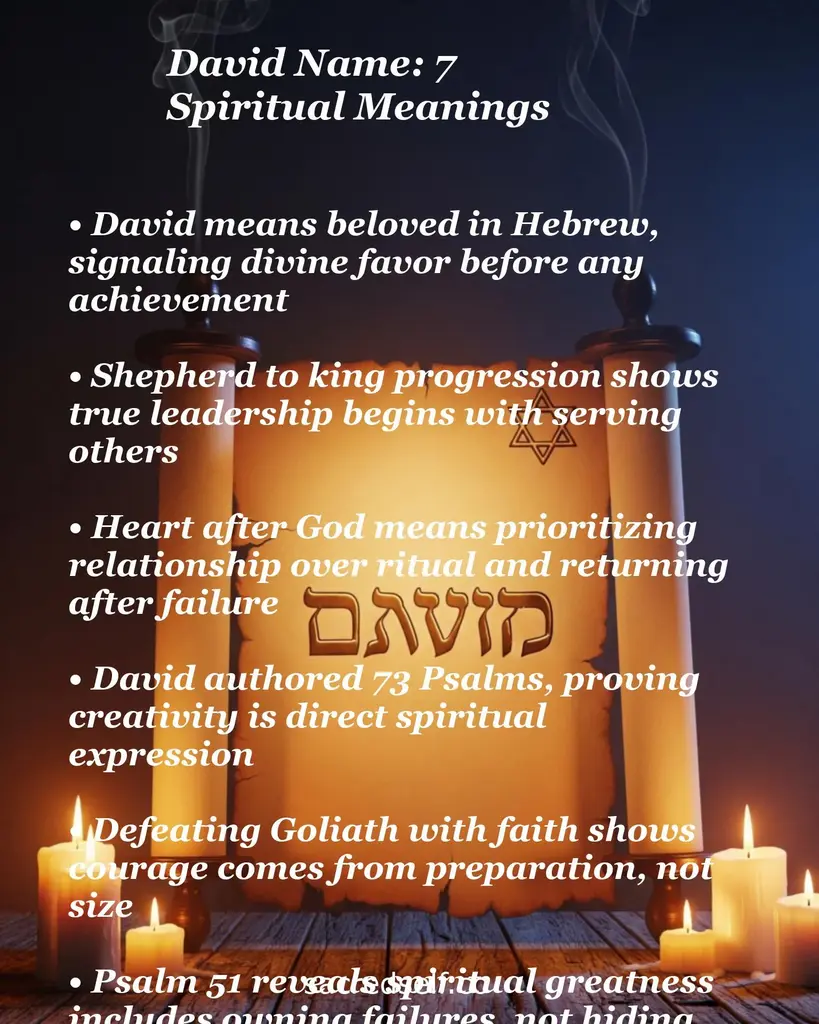
7 Spiritual Meanings of the Name David
1. Beloved of God – Divine Favor and Connection
The Hebrew root ‘dwd’ translates directly to beloved or cherished. This isn’t casual affection – it’s the kind of love that chooses, protects, and elevates. To carry the name David spiritually means carrying the identity of someone who is deeply loved by the divine, not because of achievement but because of who you are at your core.
This beloved status isn’t about perfection. David was flawed, made mistakes, and fell short repeatedly. Yet the spiritual meaning remains: you are loved before you prove yourself worthy.
When you recognize yourself as beloved, you stop performing for approval. You lead from security rather than insecurity. You create from overflow rather than lack.
Reflection: How does your life change if you truly believe you are beloved by the divine – not for what you do, but for who you are?
2. Shepherd Leadership – Caring Authority
David’s journey from shepherd boy to king is one of the most iconic spiritual progressions in religious texts. He didn’t begin in power; he began in fields, watching over sheep, learning to care for the vulnerable before he was trusted with a nation.
This represents a spiritual principle: true leadership is grounded in service. The shepherd doesn’t drive from behind; he leads from the front, knows each sheep by name, and puts himself between danger and those under his care.
In modern terms, this means leading with empathy in your sphere – whether that’s your family, your workplace, or your community. Shepherd leadership asks: Who needs protection? Who needs guidance? How can I serve those I’m responsible for?
Practical application: Identify one area where you have influence. Ask yourself if you’re leading with care or control. Adjust accordingly.
3. Heart After God – Spiritual Alignment
David is called ‘a man after God’s own heart’ in 1 Samuel 13:14 and Acts 13:22. This doesn’t mean he was sinless – it means his deepest desire was alignment with divine will, even when he failed.
A heart after God is one that seeks, asks, repents, and returns. It’s a heart that prioritizes relationship over ritual, intimacy over image. David prayed constantly, expressed raw emotion in the Psalms, and consulted God before major decisions.
This meaning invites you to ask: What does your heart chase? Where do you turn first when life gets hard?
Practical steps to align with higher purpose:
- Start a daily practice of inquiry. Ask, “What is my highest purpose today?” before making decisions.
- Prioritize connection over performance. Spend time in meditation, prayer, or stillness without an agenda.
- Practice honesty with the divine. Don’t filter your emotions – express them fully, like David did in the Psalms.
4. Creative Expression – Psalms and Worship
David was a musician, poet, and worship leader. He wrote at least 73 of the 150 Psalms, turning personal pain, joy, fear, and awe into sacred art. His harp soothed King Saul’s torment. His songs became the prayer language of generations.
This aspect of David’s meaning shows that creativity is not separate from spirituality – it’s a direct expression of it. When you create, you participate in the divine act of bringing something into existence. When you worship through art, you make the invisible visible.
The meaning here is clear: if you carry the energy of David, you are called to use your creative gifts in service of something greater than yourself.
Reflection: What creative expression feels most natural to you? How can you use it to connect with the divine or serve others?
5. Courage in Adversity – Facing Giants
The story of David and Goliath is more than a historical account – it’s a spiritual metaphor for facing what seems impossible. David, a teenager with a sling, faced a nine-foot warrior when trained soldiers wouldn’t.
His courage didn’t come from physical strength. It came from faith. He had already killed a lion and a bear while protecting his sheep. He knew what it felt like to face danger and see divine intervention.
The lesson: Your giants – fear, doubt, obstacles, oppressive systems – are not defeated by matching their size. They’re defeated by faith, preparation, and willingness to step forward when no one else will.
Practical application: Name your current ‘giant.’ What feels too big to face? Now ask: What small step can I take today, trusting that I don’t have to defeat it all at once?
6. Repentance and Restoration – Spiritual Renewal
David’s worst failures are recorded in scripture without censorship. He committed adultery with Bathsheba, orchestrated her husband’s death, and abused his power. The prophet Nathan confronted him, and David’s response was immediate: “I have sinned against the Lord.” (2 Samuel 12:13)
Psalm 51, written after this sin, is one of the most profound prayers of repentance ever recorded. It shows that spiritual greatness includes owning your failures, not hiding them.
The name David carries this energy of restoration. It says: You will mess up. You will fall short. And you can return. Repentance isn’t punishment – it’s the path back to alignment.
Personal practice: When you make a mistake, practice honest acknowledgment without self-destruction. Ask yourself: What can I learn? How can I repair? How do I return to integrity?
7. Messianic Lineage – Divine Purpose
David’s legacy extends beyond his lifetime. The Messiah in Christian theology comes from the line of David. Jesus is called the ‘Son of David’ repeatedly in the New Testament. In Jewish tradition, the awaited Messiah will be a descendant of David, restoring the throne.
This means David’s name is tied to something eternal and unfinished. He was part of a larger story, a divine plan that moved through generations.
Spiritually, this invites you to ask: What legacy are you contributing to? What role do you play in the larger spiritual story being written?
Reflection: How does it shift your perspective to see your life as part of a much larger spiritual narrative? What seeds are you planting that won’t fully bloom in your lifetime?
Cultural and Spiritual Perspectives on David
Various traditions interpret and honor the name David in distinct ways, adding layers to its meaning.
Hebrew Tradition and Etymology
In Hebrew, the name is pronounced “Dah-veed” (דָּוִד), with emphasis on the second syllable. The root dwd is tied to the word for ‘uncle,’ suggesting familial love and protection.
Rabbinical teachings highlight David as the ideal king archetype – not perfect, but aligned with God’s heart. The Talmud discusses David’s midnight study sessions, his humility despite kingship, and his role in establishing Jerusalem as a spiritual center.
In Kabbalah, David represents Malchut (Kingdom), the final sefirah on the Tree of Life, where divine energy manifests in the physical world. He embodies the principle of bringing heaven to earth.
Christian Symbolism
In Christian theology, David is seen as a Christ-type, a foreshadowing of Jesus. Both were born in Bethlehem, both shepherds, both kings, both from the tribe of Judah. The title ‘Son of David’ appears 17 times in the Gospel of Matthew alone.
David’s psalms are central to Christian worship and prayer. Psalm 23 (“The Lord is my shepherd”) and Psalm 51 (confession and repentance) are cornerstones of Christian spirituality.
David’s life shows that God works through imperfect people. His failures don’t disqualify him – they make his faith more relatable and his restoration more powerful.
Islamic Perspective (Dawud)
In Islam, David is known as Dawud (داوود), a prophet and king blessed with wisdom, strength, and the ability to glorify God through sound. The Quran mentions him 16 times, highlighting his judgment, devotion, and the gift of the Psalms (Zabur).
Surah 38:17-26 describes how Dawud would spend part of the night in worship and was given profound wisdom in judgment. His ability to soften iron and create armor is mentioned, symbolizing strength and protection.
The emphasis in Islamic tradition is on Dawud’s remembrance of God (dhikr), his repentance, and his role as a just leader. He is a model of how power should be used: with humility and accountability to the divine.
Greek and Latin Interpretations
When the Hebrew Bible was translated into Greek (the Septuagint), David became Δαυίδ (Dauid), keeping the core meaning but adapting pronunciation. In Latin, it became David, the form most Western cultures use today.
The name spread across Europe through Christianity, becoming popular in medieval times as a symbol of righteous kingship and divine favor. Saints, kings, and scholars bore the name, reinforcing its association with leadership and spiritual depth.
The universal themes in David’s story – courage, creativity, repentance, and purpose – transcend language and culture. Whether in Hebrew, Arabic, Greek, or English, the essence remains: this is a name tied to divine love and calling.
🦋 Continue your journey with: Spiritual Meaning Of The Name Michael
Living the Qualities of David
If you carry the name David, or feel drawn to its meaning, here’s how to embody its qualities in daily life.
Personal Reflection Questions
What does being ‘beloved’ mean in your spiritual journey?
Do you live from a place of feeling chosen and cherished, or are you still trying to earn love? Notice where you perform for approval. Ask yourself what would change if you truly believed you were already beloved.
How do you balance humility with leadership?
David never forgot his shepherd roots, even as king. Where in your life are you called to lead? Are you leading with ego or with service? Humility doesn’t mean hiding your gifts – it means using them for others.
Where do you need courage in your current situation?
What’s your Goliath right now? What fear, obstacle, or challenge feels too big? David didn’t wait to feel ready – he stepped forward with what he had. What small action can you take today?
What creative gifts are you being called to use?
David’s music and poetry were acts of worship. What creative expression feels alive in you? How can you use it to connect with the divine or serve your community?
Practical Spiritual Practices
Meditation on the qualities of David:
- Sit quietly and visualize yourself as ‘beloved.’ Feel what it’s like to be chosen, protected, and cherished by the divine.
- Breathe in courage, creativity, and humility. Breathe out fear, performance, and ego.
- Repeat silently: “I am beloved. I am called. I am enough.”
Journaling prompts for self-discovery:
- What does leadership look like in my current season of life?
- Where have I failed, and what did I learn from it?
- If I lived as someone ‘after God’s heart,’ what would I do differently?
- What giant am I avoiding, and why?
Ways to cultivate shepherd-heart leadership:
- Practice listening more than directing. Ask those you lead what they need.
- Protect the vulnerable. Stand between harm and those who can’t defend themselves.
- Lead by example, not by authority. Do the hard things first.
Developing creative spiritual expression:
- Write your own psalm – raw, honest, unfiltered emotion directed toward the divine.
- Use music, art, or movement as prayer. Don’t worry about skill; focus on connection.
- Create something that serves others: a song, a poem, a meal, a space of beauty.
Frequently Asked Questions
What is the deep meaning of David?
The name David means ‘beloved’ – someone cherished by the divine. The biblical David’s life adds deeper meaning: transformation from humble shepherd to anointed king, creative worship, courage facing giants, and authentic repentance after failure. The name carries the identity of being loved, called, and restored no matter how far you fall.
What makes David so special?
David is special because he combined humility with strength, creativity with courage, and failure with repentance. He wasn’t a perfect hero – he was deeply flawed. But he was willing to be honest with God, to return when he strayed, and to use his gifts in service of something greater. His specialness is in his humanity paired with his devotion.
What is the spiritual significance of David?
David represents the archetypal journey from calling to fulfillment. He was anointed as a boy but didn’t become king for years. He faced rejection, danger, and moral failure. His life teaches that spiritual growth is not linear – it includes waiting, fighting, creating, repenting, and trusting God’s timing. For modern seekers, David’s story says: You are beloved, you are called, and your failures don’t disqualify you.
What are 5 facts about David?
- Born in Bethlehem, the youngest of eight sons, initially overlooked when the prophet Samuel came to anoint a new king.
- Defeated Goliath as a teenager with only a sling and five stones, trusting God rather than armor.
- Wrote at least 73 Psalms, creating a prayer and worship language still used today.
- Became king of Israel at 30, reigning for 40 years and establishing Jerusalem as the spiritual and political center.
- Committed serious sins (adultery, murder) but is still called ‘a man after God’s own heart’ because of his repentance and desire for alignment with God.
What does David mean in Hebrew pronunciation?
In Hebrew, David is pronounced “Dah-veed” (דָּוִד), with the emphasis on the second syllable. The root dwd means ‘beloved’ or ‘cherished.’ Pronunciation matters because it connects you to the original intention of the name – it’s not just a label, it’s a declaration of identity. When you say “Dah-veed,” you’re speaking the word for ‘beloved’ in the language it was first given.
How old is the name David?
The name David is over 3,000 years old, dating back roughly to 1040-970 BCE when the biblical David lived. It appears in ancient Hebrew texts and has been used continuously across Jewish, Christian, and Islamic traditions. Ancient names carry spiritual weight because they’ve been spoken, prayed, and lived by millions across millennia, adding to their resonance.
What is another name for David in the Bible?
David is sometimes called by titles rather than alternative names: ‘Son of Jesse’ emphasizes his family line, and ‘the sweet psalmist of Israel’ (2 Samuel 23:1) highlights his role as worship leader and poet. In the New Testament, Jesus is called ‘Son of David,’ linking Him to David’s messianic line. These titles add layers – David is not just an individual, but part of a larger spiritual genealogy.
Does the meaning change if you’re not religious?
The core meaning of ‘beloved’ stays universal, even outside religion. You don’t have to believe in God to appreciate being deeply loved, leading with care, facing fears with courage, or owning mistakes and growing. David’s story teaches timeless lessons: the underdog who rises, the artist who creates from pain, the leader who serves, the human who fails and finds redemption. These principles go beyond religious labels.
Final Thoughts
The name David is more than a historical marker or a popular choice – it’s a powerful identity. To be called ‘beloved’ means living from divine favor, not earned but given. To walk in David’s energy means embracing leadership through service, creativity as worship, courage in the face of giants, and grace when you fall.
Whether you carry this name, are naming a child, or feel drawn to its lessons, ask yourself: What does it look like to live as someone beloved?
What part of David’s journey speaks to where you are? Is it courage to face a big challenge? A call to create something meaningful? The need to repent and restore? Or the reminder you are cherished, chosen, and called – not for what you do, but for who you are?
Share your connection to the name David in the comments below. We’d love to hear how this name has shaped your life or what it means to you now.
Namaste. 🙏
🦋 You might also find this valuable: Stepping In Dog Poop Spiritual Meaning