Humans have always needed reminders of their own bravery. When fear feels louder than conviction, a symbol can act as an anchor: not magic, but a visual prompt that reconnects you to what you’re capable of.
Courage symbols appear across every culture, often featuring animals that face danger without hesitation or endure harsh conditions without complaint. Some represent bold action, charging forward despite obstacles. Others represent persistence, standing firm when everything tells you to fold.
The symbol that matters most is the one that resonates with your personal understanding of bravery. Whether you’re looking for inspiration during a difficult time, considering a tattoo, or simply trying to understand what courage means to you right now, these symbols offer different mirrors for different moments.
Key Takeaways
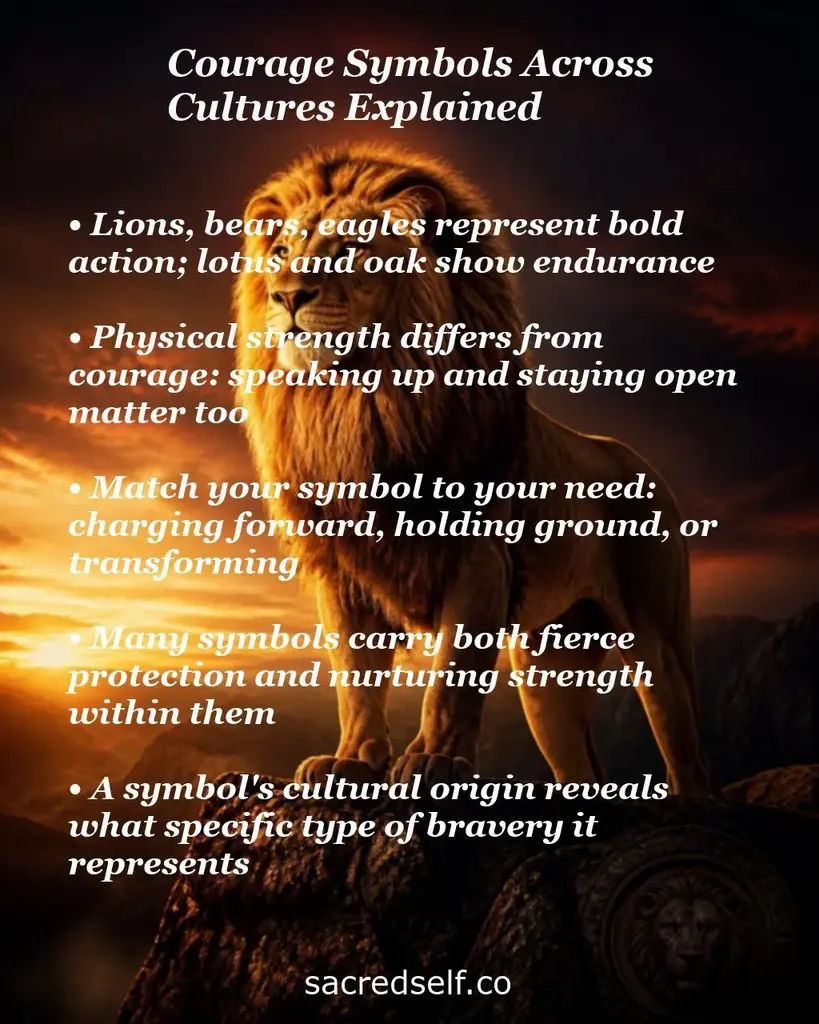
- Courage symbols span every culture, from fierce protectors like lions and bears to symbols of endurance like oak trees and lotus flowers
- Physical strength and courage often overlap, but courage can also mean speaking up, remaining open under pressure, or showing up daily despite difficulty
- The most meaningful symbol connects to your specific situation: whether you need to charge forward, stand your ground, or transform through hardship
- Many symbols represent both aggressive protection and nurturing strength, reflecting different forms of bravery
- Understanding a symbol’s origins can help clarify what courage means to you, even if you choose something entirely personal
📿 Top picks on Amazon: Best Wood Malas
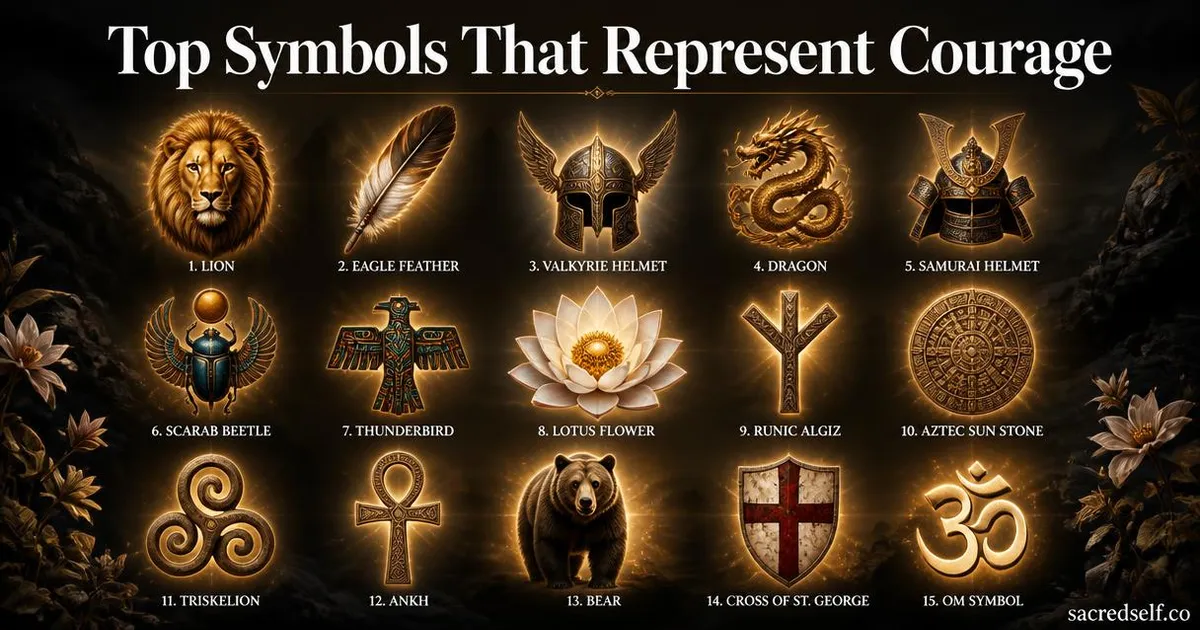
15 Symbols That Represent Courage Across Cultures
These symbols carry cultural weight and personal resonance. Each represents a different type of bravery, from bold leadership to gradual transformation.
1. Lion
Known as the king of beasts, the lion represents fearless leadership and protective courage. It appears in European heraldry, African oral traditions, and Asian symbolism as a creature that defends its pride without hesitation.
This symbol resonates when you’re facing leadership challenges, needing to protect others, or stepping into visibility despite discomfort.
Where in your life are you being called to lead or defend something important?
2. Golden Eagle
Eagles soar at great heights and face storms head-on rather than seeking shelter. They maintain clear vision even during chaos, rising above danger to see the larger pattern.
Native American traditions honor the eagle as a warrior symbol, while Roman legions carried eagle standards into battle. This symbol connects to courage that requires perspective, the ability to rise above conflict rather than get consumed by it.
Consider what you need to rise above versus what requires direct confrontation.
3. Bear
The bear is a fierce protector, willing to fight when threatened, but also represents solitary strength. It draws on inner reserves and stands its ground without needing validation or backup.
Native American traditions honor the bear as a strength symbol. Norse berserker warriors channeled bear energy in battle. Celtic traditions saw bears as guardians of sacred boundaries.
This symbol resonates when you’re protecting boundaries, drawing on reserves you didn’t know you had, or standing firm when others expect you to move.
Is your courage needed for protection, or are you being called to assert a boundary?
4. Wolf
Wolves hunt strategically, protect the pack, and face danger as a coordinated group. They represent courage that comes from community, bravery that doesn’t require isolation.
Roman mythology credits a wolf with nursing Romulus and Remus. Norse traditions feature Fenrir, the great wolf. Native American stories honor wolves as symbols of loyalty and strategic thinking.
This symbol speaks to finding courage through connection, taking calculated risks, and protecting those you consider family.
Who are your pack members who give you courage? Can you reach out?
5. Oak Tree
The oak withstands storms, grows slowly but unshakably, and provides shelter while remaining rooted. It represents the courage of endurance, staying grounded during upheaval rather than fighting every gust of wind.
Celtic traditions revered oaks as symbols of strength. Greek mythology associated oaks with Zeus. European folklore saw them as endurance symbols that outlived generations.
This symbol resonates when you need to endure rather than fight, when the brave thing is to stay rather than leave, when patience requires more courage than action.
What in your life requires patient, sustained courage rather than a single bold act?
6. Dragon
Dragons represent facing fear itself. In Western traditions, slaying a dragon means overcoming terror, the knight’s trial that proves courage. In Eastern traditions, dragons embody wise courage, power tempered with intelligence.
This symbol works when you’re facing your biggest fears or transforming your relationship with what scares you. The dragon reminds you that sometimes courage means confronting, and sometimes it means integrating.
Note: The cultural difference matters. European dragons often represent evil to be conquered. Far Eastern dragons represent protective wisdom and benevolent power.
7. Boar
The boar charges forward despite danger, fights fiercely when cornered, and doesn’t retreat. Celtic warriors adopted the boar as a symbol. Norse mythology associates boars with Freya. Greek mythology features the Calydonian boar as a fearsome trial.
This symbol speaks to courage that requires direct confrontation, pushing through obstacles, refusing to back down, meeting challenges head-on.
Is charging forward the right move, or do you need strategic patience?
8. Scarab Beetle (Khepri)
The scarab rolls its burden uphill repeatedly, representing persistent transformation and rebirth through daily effort. Ancient Egyptians saw the scarab as Khepri, the god who pushed the sun across the sky each day, a symbol of the courage required to show up again and again.
This isn’t dramatic bravery. It’s the courage of repetition, of doing the hard thing today and then waking up and doing it again tomorrow.
What small action can you take daily that requires sustained courage?
9. Djed Pillar
The djed pillar represents stability and backbone, standing upright despite pressure. Ancient Egyptians associated it with Osiris’s spine and performed “raising the djed” ceremonies to symbolize restoration of strength.
This symbol resonates when you need to maintain integrity under pressure, when the brave thing is refusing to bend, when courage means keeping your spine straight.
Where do you need to stiffen your spine or refuse to compromise?
10. Okodee Mmowere (Adinkra Symbol)
This Adinkra symbol means “talons of the eagle” and represents strength, bravery, and power. The Akan people of West Africa developed Adinkra symbols as a visual language, and this one specifically honors warrior courage.
It’s still used in Ghanaian art and represents courage that grasps opportunities despite fear, active claiming of power rather than passive waiting.
Note: This is part of a larger symbol system where each icon carries specific wisdom passed down through generations.
11. Lotus Flower
The lotus blooms beautifully despite growing in mud. It represents the courage to transform through difficulty, to not just survive messy circumstances but to grow because of them.
Buddhist traditions see the lotus as an enlightenment symbol. Egyptian mythology associated it with rebirth. Hindu traditions honor it as purity emerging through adversity.
This symbol speaks to finding courage when circumstances feel impossible, when growth requires staying in discomfort, when beauty emerges from struggle.
What difficult situation might be the mud that helps you bloom?
12. Thor’s Hammer (Mjölnir)
Mjölnir represents Norse protective courage, the strength to defend against chaos and destruction. Viking warriors wore it as a symbol of Thor’s protection. Modern Heathen practitioners still use it as a sacred symbol.
This speaks to defensive courage, protecting what matters, facing destructive forces, standing between threat and vulnerability.
What are you protecting, and does it truly need your defensive energy right now?
13. Griffin
The griffin combines lion and eagle, courage on land and in air, guardianship that spans multiple realms. Ancient Persian traditions featured griffins as guardians. Greek mythology saw them as divine watchers. Medieval European heraldry used them to represent sacred duty.
This symbol resonates when you’re guarding something precious, when courage comes from a sense of responsibility, when bravery feels like a calling rather than a choice.
Note: Griffins often represent courage that comes from protecting something sacred, not just personal bravery but duty-bound courage.
14. Red Color/Symbols
Red is the color of blood, fire, and life force. It appears across cultures as boldness and vitality. Roman mythology associated red with Mars, god of war. Chinese traditions connect red to courage and good fortune. Native American sacred practices honor red as a color of power.
This symbol resonates when you need to feel energized, visible, or vital, when courage requires showing up fully rather than hiding.
Notice if you’re drawn to or avoiding red: both can reveal something about your relationship with courage right now.
15. Six-Petal Rosette
This ancient symbol appears across Mesopotamian, Egyptian, and Mediterranean cultures as a representation of life force, solar power, and the courage that comes from connection to source energy.
It resonates when your courage feels isolated, when you need to remember you’re part of something larger, when bravery requires reconnecting with your core.
Does your courage feel isolated, or can you draw on a sense of connection?
Masculine and Feminine Forms of Courage
Courage isn’t one-dimensional. Different situations call for different types of bravery, and understanding the difference can help you recognize what you actually need.
Masculine courage symbols emphasize outward action, direct confrontation, and protective aggression. Lions, bears, boars, and weapons fall into this category. This type of courage is relevant when facing visible challenges, needing to assert or defend, or demonstrating public bravery.
Feminine courage symbols emphasize endurance, transformation through difficulty, and nurturing strength. The lotus, tree of life, and mother bear represent this form. This courage matters during sustained challenges, when strength must be private, or when bravery means remaining open while under pressure.
Complete courage often requires both forms, knowing when to push and when to endure, when to fight and when to grow through difficulty.
Which form of courage do you typically rely on? Which might you need to develop?
Cultural and Spiritual Perspectives on Courage Symbols
Different traditions offer distinct perspectives on what courage looks like and how symbols represent it. Understanding these contexts can deepen your connection to a symbol or help you choose one that fits your situation.
Native American Courage Symbols
Eagle feathers are earned through brave deeds in many Native American traditions, representing the connection between courage and spiritual height. The bear symbolizes solitary strength, protective ferocity, and healing courage. The wolf represents pack loyalty, strategic bravery, and the balance between independence and community.
An important context: these symbols are often earned or received, not just chosen. Courage is proven through action, then honored with the symbol.
European and Celtic Courage Symbols
The oak tree represents endurance, ancient wisdom, and deep roots during storms. The boar symbolizes fierce forward momentum and warrior spirit. Celtic knots show interconnected courage, strength that comes through connection rather than isolation.
The heraldry tradition passed family symbols down through generations, each representing ancestral bravery that descendants were expected to honor and continue.
African and Middle Eastern Courage Symbols
Adinkra symbols from West Africa include Okodee Mmowere (eagle talons) and Dwennimmen (ram’s horns). Ancient Egypt honored the scarab beetle as daily courage of transformation and rebirth. The djed pillar represented standing firm and maintaining backbone.
The lion appears across North African and Middle Eastern traditions as royal courage, the bravery of leadership and protection.
Far Eastern Courage Symbols
The dragon represents wise courage and power tempered with intelligence, different from European dragons as representations of evil. The lotus symbolizes courage to transform through difficulty, growing beautifully despite circumstances.
The tiger represents direct action and protective ferocity. The koi fish swimming upstream symbolizes courage to persist against the current, with eventual transformation as the reward.
Greek and Norse Courage Symbols
Greek mythology features the lion (Nemean lion), griffin (guardian courage), and boar (Calydonian boar). Norse traditions honor Mjölnir (Thor’s hammer for protective courage), the wolf (Fenrir representing wild courage), and ravens (Odin’s messengers representing brave wisdom).
Both cultures developed warrior traditions where courage symbols were earned through trials, not decorative, but commemorative.
🦋 Readers also searched for: Bald Eagle Spiritual Meaning
What Should I Do With This Information?
If you’re researching for personal use, notice which symbols make you feel something. That emotional response matters more than historical tradition or cultural weight.
If you’re choosing a symbol for a tattoo, art piece, or daily reminder, spend time with it first. Does it represent who you are now or who you want to become? Both are valid, but knowing the difference matters.
If you’re facing a specific challenge, match the symbol to the type of courage you need. Do you need to charge forward? Endure patiently? Protect boundaries? Transform through difficulty?
Practical steps:
- Journal: “What does courage mean to me right now?”
- Consider: Which symbol’s story most mirrors your current situation?
- Try: Keep an image of your chosen symbol somewhere visible for a week and notice if it shifts how you feel
- Remember: The symbol reminds you of courage you already have, it’s not a source of new courage
Reflecting on Your Own Symbol of Courage
These traditional symbols offer starting points, but your personal symbol might be something entirely different. Maybe it’s a family heirloom, a place you visited during a difficult time, or an image connected to a moment when you were brave.
Questions to explore:
- When have you been brave before? What reminds you of that moment?
- What animal, plant, or image makes you feel stronger when you see it?
- Does your courage look like bold action, endurance, or something else entirely?
Consider creating or identifying your own symbol. The power comes from the meaning you give it, not from its historical weight or cultural recognition.
Frequently Asked Questions
What are the 7 types of courage?
Physical courage (facing bodily harm), moral courage (standing up for beliefs), emotional courage (being vulnerable), intellectual courage (questioning assumptions), social courage (risking rejection), creative courage (sharing original work), and spiritual courage (facing existential questions).
Different courage symbols represent different types. The eagle might represent physical or spiritual courage, rising above danger or connecting to something higher. The lotus represents emotional or transformative courage, growing through difficulty. The lion represents moral and physical courage, defending what matters.
What is a symbol for courage?
The lion is probably the most universally recognized courage symbol, representing fearless leadership and protective bravery. Eagles, bears, oak trees, dragons, and many other symbols also represent courage across different cultures.
The best symbol depends on what type of courage resonates with you. Bold action? Endurance? Protective strength? Transformative persistence? Match the symbol to what you actually need.
What are the most powerful symbols?
Power depends on context and tradition. Lions, eagles, and dragons appear across multiple cultures as powerful courage symbols. The oak tree represents enduring power. Thor’s hammer and the djed pillar represent strength and stability.
A symbol becomes powerful when it connects to your personal understanding of courage and strength. Historical weight matters less than personal resonance.
What symbolizes fearless?
Animals that face danger head-on typically symbolize fearlessness: lions confronting threats, eagles flying into storms, boars charging forward, and honey badgers (a modern symbol of fearless persistence).
However, true fearlessness is rare. Most courage symbols actually represent acting despite fear, not being without it. The lotus grows through mud, that’s courage, not fearlessness. The distinction matters.
What characters represent courage?
Historically, warriors like Achilles, Joan of Arc, or Samurai represent martial courage. Mythologically, heroes who face trials – Hercules, Odysseus, Mulan – embody different forms of bravery.
In modern stories, characters who act despite fear tend to resonate more than fearless warriors. Those who grow into courage feel more real and accessible. If you’re drawn to a particular character, consider what type of bravery they represent and whether that’s what you need right now.
Which Disney characters are known for their courage?
Mulan acts despite fear to protect family. Simba faces his past and accepts responsibility. Moana ventures into the unknown despite her father’s warnings. Merida is brave in both title and action, defying expectations.
These represent different courage types: duty, redemption, exploration, and defiance. If you’re drawn to one of these characters, pay attention to which type of courage they embody, it might reflect what you need to cultivate.
What’s the difference between strength symbols and courage symbols?
They overlap significantly. Strength symbols like the bear, oak tree, and djed pillar often represent physical power or endurance. Courage symbols emphasize facing fear or danger, acting despite threat.
Many symbols represent both. A lion has physical strength and the courage to fight. If you’re choosing between them, ask yourself: Do I need to remember I’m strong, or do I need to remember to act despite being scared?
Can I use a courage symbol from a culture that’s not mine?
Approach with respect and awareness. Some symbols – eagles, lions, oaks – appear across many cultures and are broadly accessible. Others carry specific cultural or spiritual weight.
Adinkra symbols are part of a living West African tradition but are generally shared openly. Native American eagle feathers are earned symbols within closed practices, not appropriate for outsiders to adopt. Specific Norse religious symbols have meaning within modern Heathen practice that should be respected.
Research the symbol’s origin and current use. If it’s a closed practice or earned symbol, choose something else. If it’s shared across cultures or openly offered, you can connect with it respectfully: learn its real meaning, don’t just use it as decoration.
🦋 Continue your journey with: Spiritual Meaning Of Lady Bug
Final Thoughts
Courage symbols across cultures remind us that bravery takes many forms. Charging forward, standing firm, enduring patiently, transforming through difficulty, protecting what matters – all require courage, just different kinds.
The symbol you choose or connect with isn’t as important as what it helps you remember about yourself. You’ve been brave before. You can be brave again.
What does courage look like for you in this specific moment? What symbol would remind you of that when things feel hard?
If a particular symbol spoke to you while reading this, pay attention to that. Your intuition might be highlighting exactly what you need to remember right now. Share in the comments which symbol resonates and why – your story might be exactly what someone else needs to hear.
Namaste. 🙏