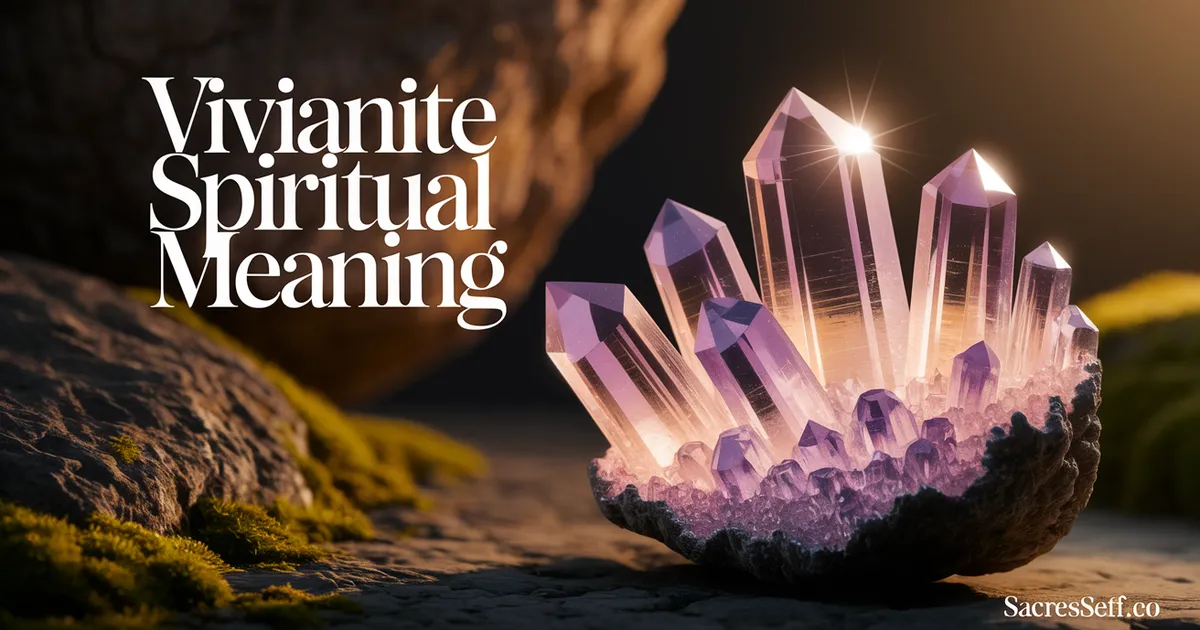
Vivianite spiritually represents clarity, honest self-perception, and healing after loss. People drawn to transformation, grief work, and ancestral connection tend to seek it out, partly because of its striking color shift and partly because of its habit of forming on ancient bones.
It is a fragile iron phosphate mineral that starts colorless and slowly deepens to rich blue and green as it meets light and air. If you are working through loss, exploring ancestral roots, or simply feel pulled toward rare and unusual stones, vivianite is one many people find during periods of loss or change.
Key Takeaways
- Vivianite is primarily associated with clarity and emotional transparency, helping you see situations or relationships more honestly.
- It is linked to the Third Eye chakra (Ajna), making it a stone people reach for when they want stronger intuition or mental stillness.
- Traditionally believed to ease grief and support connection with ancestors
- Vivianite fades permanently when exposed to prolonged light, which affects both how you care for it and how you use it metaphysically.
- Vivianite is toxic: avoid water elixirs or handled with broken skin.
- Genuine vivianite is fragile and rare, so unusually bright or uniform specimens deserve a closer look.
💫 Hand-picked for your practice: Best Gifts For Spiritual Person
6 Spiritual Meanings of Vivianite
Vivianite shows up in spiritual practice in a few distinct ways.
1. Clarity and Honest Self-Perception
Vivianite is linked to seeing yourself and your circumstances without distortion, especially when something has been hard to admit. It comes up when you feel confused about a relationship, a decision, or your own motivations and need a clearer view.
Maybe you have been telling yourself a friendship is fine when it really isn’t, or you keep saying yes to things you do not want. You might hold vivianite while you sit with it and ask yourself what you have been avoiding looking at directly.
2. Grief, Loss, and Gentle Healing
This stone is traditionally associated with sitting with sorrow instead of rushing past it, and finding peace in what has ended. It fits the period after a death, a breakup, or any significant ending when you need something to hold during the still moments.
Some people hold vivianite while looking at photos of someone they have lost, or while writing about that person in a journal.
3. Ancestral Connection and Memory
Vivianite is tied to communication with ancestors or the energy of those who came before, partly because of its natural formation near human remains. It fits anyone doing family history work, maintaining ancestor altars, or performing rituals to honor the dead.
If you are researching your family tree or setting up a space to honor your grandparents and great-grandparents, vivianite can sit on the altar as a physical anchor. What did the people before you carry that you may still be carrying?
4. Spiritual Rebirth and Personal Transformation
The stone’s color shift is read as a symbol of becoming, of revealing what was always there but hidden. It fits transitions such as leaving a belief system, a career, or a version of yourself that no longer fits.
Say you are in the middle of changing careers or walking away from a religion you grew up in. One way to use it is placing vivianite on your altar or desk during a period of intentional change as a visual anchor for the process.
5. Third Eye Awakening and Intuition
Many people reach for vivianite to quiet mental noise so that gut feelings and inner knowing become easier to notice. It fits people who feel mentally scattered or who second-guess their instincts frequently.
Think about a time you had a strong feeling about something but talked yourself out of it. When did you last trust a feeling before you could explain it, and what happened?
6. Protection from Negative Patterns and Energy
Vivianite is believed to help clear repetitive negative thoughts or draining dynamics within you. People use it for situations where they keep returning to the same worry, habit, or difficult relationship pattern.
If you notice yourself replaying the same anxious loop every night before bed, some people set vivianite near their journaling space when working through a recurring emotional pattern.
What Vivianite Is and Where It Comes From
Vivianite is a natural iron phosphate mineral, first found in Cornwall, UK, and named after the mineralogist John Henry Vivian. It starts colorless or pale and oxidizes to deep blue, blue green, or greenish black over time as it is exposed to light and air.
It is found in a small number of locations worldwide and is considered rare and fragile, with a low hardness on the Mohs scale. One of its most notable characteristics is that it forms naturally on bones and fossils in low oxygen conditions, which is part of why it carries such strong associations with death, memory, and ancestry.
Vivianite Chakra and Zodiac Connections
Vivianite is most often linked to the Third Eye chakra (Ajna), the energy center associated with intuition, inner sight, and mental clarity. The deep blue color and the stone’s connection to seeing more clearly are the traditional reasons for this link.
As for zodiac connections, there is no widely agreed-upon association between vivianite and any specific astrological sign. Different sources may list various signs, but none are consistently confirmed across crystal reference texts.
How to Use Vivianite
You can work with vivianite in a few simple ways.
- Hold it or place it near you during meditation focused on clarity or grief
- Use it on an ancestor altar or during remembrance rituals
- Keep it in your journaling space when working through a recurring pattern or transition
- Include it in witchcraft or ritual practice where ancestral energy or protection from negativity is the intention
Remember that crystals support wellbeing practices and do not replace medical care.
🦋 This may also speak to you: Crystals For Love
Is Vivianite Safe? Water, Handling, and Elixirs
Vivianite is toxic and must not be used in water elixirs or gem infused drinks.
Avoid handling vivianite with broken or sensitive skin, and wash your hands after contact. It is not safe for extended direct contact with the body in sensitive areas, and water exposure can damage the stone’s structure and accelerate unwanted changes to its color.
Real vs Fake Vivianite: How to Tell
Genuine vivianite is fragile and shifts color with light exposure. If you are looking at a specimen that shows unusually uniform, bright color with no matrix and a very low price, that is worth examining closely.
One way to test is the color change: real vivianite darkens from pale to blue green with light exposure, while dyed or coated stones do not behave this way. Because vivianite is rare, very cheap pieces sold in large quantity are worth questioning.
How to Cleanse and Charge Vivianite
Safe cleansing methods include sound, breath, selenite, and moonlight. You can use singing bowls, bells, or simply hold the stone and breathe over it intentionally.
Avoid water, salt water, and prolonged sunlight, all of which can cause permanent fading and color loss. Store vivianite away from direct light in a padded container to preserve both its color and its physical integrity.
🦋 You might also be interested in: Chinese Zodiac Snake
FAQs About Vivianite
People often have practical questions about vivianite before buying or working with it.
Can vivianite actually grow on corpses?
Yes, vivianite can form on human remains in certain conditions. It grows in low oxygen, phosphate-rich environments, which bones and decomposing organic material can provide. This is why it is sometimes found on ancient bones and fossils, and it is part of the reason the stone carries such strong associations with death and ancestry.
How rare is vivianite, and why is it so expensive?
Vivianite is considered rare and is found in only a small number of locations worldwide. Its low hardness and fragility make it difficult to mine, cut, and transport without damage, which adds to the cost. Good quality specimens with rich color are harder to come by, and that scarcity drives the price up.
What is vivianite used for in witchcraft?
In witchcraft and ritual practice, vivianite is most often used for ancestral work and protection from negativity. Practitioners place it on altars dedicated to ancestors or use it in rituals that involve remembrance, grief, or clearing repetitive negative patterns. Because it is toxic, it is handled carefully and never used in anything that involves ingestion.
Is vivianite fragile enough to limit jewelry use?
Yes, vivianite’s low hardness and fragility make it a poor choice for most jewelry. It can scratch and break easily, and prolonged exposure to light causes permanent fading, which makes it impractical for rings or everyday wear pieces. Most vivianite is kept as a specimen or used in spiritual practice rather than worn.
Final Thoughts
Vivianite is a stone that carries the weight of endings and the quiet that follows. Its rarity and physical fragility are part of what makes it feel significant to those who seek it out. What in your life is in the middle of changing color?
Share your thoughts in the comments below.
Namaste. 🙏