
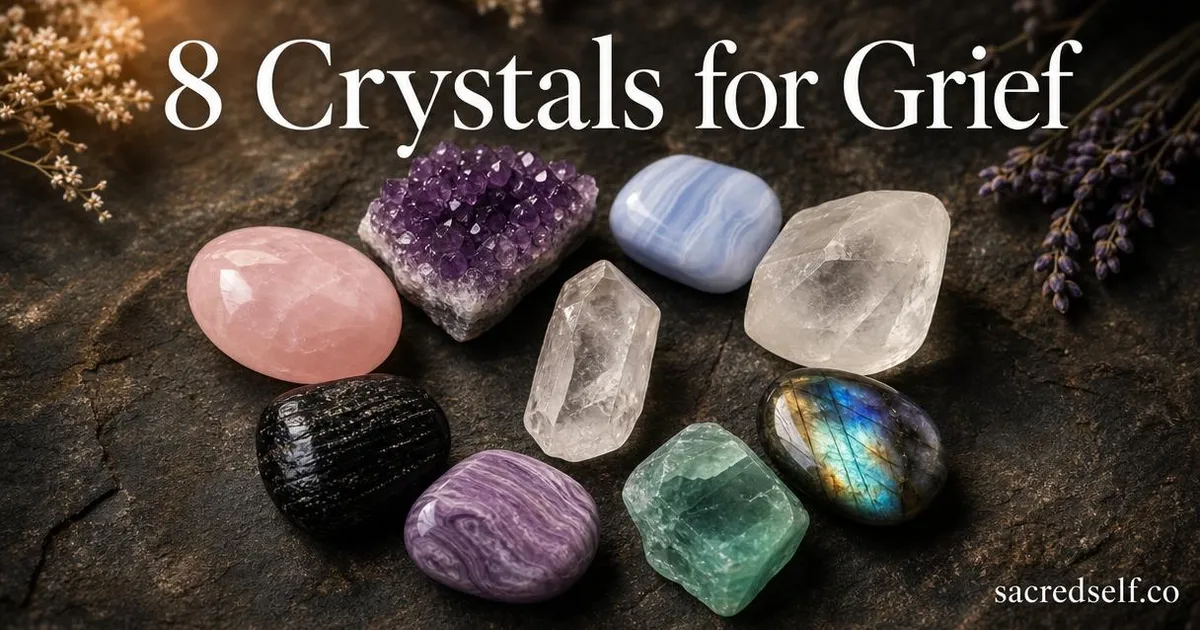
Grief knocks everything sideways, and a lot of people reach for something they can physically hold when the feelings get too big for words. Crystals can be a companion while you move through loss, and they can give you something steady to hold onto during the hardest parts.
This article covers which stones suit different kinds of grief, simple ways to use them, and how to set up a small space at home where your grief has somewhere to rest besides your own mind.
Key Takeaways
- Apache Tears is the most traditional stone associated with mourning and a natural starting point for many people.
- Amethyst is widely recommended for the emotional overwhelm that comes in waves during mourning.
- Matching a crystal to the specific loss helps narrow the choice, whether you’re grieving a parent, a pet, or a sudden death.
- Holding, carrying, or placing a crystal near your bed are the simplest ways to begin, and no ritual is required.
- Crystals work best alongside other forms of support such as talking to someone or getting enough rest.
🪷 See our favorite picks on Amazon: Best Spiritual Books For Beginners
8 Crystals for Grief
Crystals support wellbeing practices and do not replace medical or mental health care.
1. Apache Tears
Apache Tears have a long history in Indigenous tradition as a stone of mourning and compassion for those left behind after a loss. They’re a type of obsidian, small and usually dark, and crystal practitioners often recommend them for the raw early days when loss feels sudden or shocking.
The sadness hits hard, out of nowhere, while you sit on the edge of your bed. Hold a small Apache Tears stone in your palm during that moment and notice whether the physical weight feels grounding.
2. Amethyst
Amethyst is the stone people reach for when emotional turbulence and mental restlessness take over during mourning. It’s a purple quartz that crystal healers most often link to calming the mind, and it comes up frequently for nights when sleep feels impossible after a loss.
At 2 a.m. the same thoughts circle with no rest in sight. Is the hardest part of your grief happening at night, or during the still moments of the day?
3. Rose Quartz
Rose Quartz is tied to compassion for yourself and emotional release, especially when grief turns inward as guilt or blame directed at yourself. It’s a soft pink stone that crystal tradition associates with the heart chakra (Anahata), and it’s often recommended for grief that includes regret about things left unsaid or undone.
You keep replaying a conversation you wish had gone differently, or a call you meant to make and didn’t. Place Rose Quartz on your nightstand or somewhere you rest, and let it serve as a reminder to extend the same kindness to yourself that you’d offer a friend.
4. Moonstone
Moonstone is linked to emotional cycles and the understanding that grief arrives in waves. It has a milky, iridescent surface, and crystal practitioners often recommend it for moments when grief resurfaces unexpectedly, weeks or months after you thought you were doing okay.
A song comes on while driving to work, or you see someone who looks like the person you lost, and the grief is right there again as if no time had passed. Does your grief feel like it comes and goes without warning, or does it sit with you steadily?
5. Angelite
In crystal tradition, Angelite is associated with peace and spiritual comfort along with the sense of continued connection to those who have passed. It’s a pale blue stone, and people often turn to it for grief that carries a spiritual or existential dimension, such as questioning what happens after death.
You find yourself wondering where the person you lost is now, whether they’re at peace, whether consciousness continues in some form. Set Angelite on a small surface where you light a candle or sit for a while, as a physical anchor for those reflections.
6. Rhodonite
Rhodonite is linked to emotional balance and finding a path forward without dismissing the pain of loss. It’s a stone with pink and black markings, and crystal healers often recommend it for a later stage of grief when you’re ready to slowly step back into daily life but still need support.
Phone calls go out again. The grocery store feels possible. Maybe even plans for next month. Are you at the stage where moving forward feels possible, or does that thought still feel far away?
7. Howlite
Howlite is associated with calming an overactive mind and easing the tension that grief often stores in the body. It’s a white stone with grey veining, and it comes up most for the physical side of grief: jaw tension, restlessness, or an inability to relax even when you’re exhausted.
Your shoulders are up near your ears and you didn’t notice until someone pointed it out. Place Howlite under your pillow or on a bedside table on evenings when your body feels wound tight.
8. Clear Quartz
In crystal practice, Clear Quartz amplifies intention and clarity, which helps when grief leaves you feeling directionless. It’s clear and colorless, and people often pair it with another grief crystal to deepen that stone’s effect, or use it alone when no single emotion dominates.
Not knowing what you need is part of it. Maybe comfort, maybe clarity, maybe just something to hold in your hand. Is what you need right now emotional comfort, mental clarity, or simply something to hold?
How Crystals Can Support the Grieving Heart
Grief is disorienting, and a crystal gives you something physical to hold during an experience that’s hard to pin down. You can feel its weight and temperature, turn it over in your hand, and that simple sensory engagement can bring you into the present moment when emotions feel overwhelming or numb.
Returning to the same stone each day creates a small rhythm that can anchor you when everything else feels unsteady. You don’t need to do anything elaborate. Just picking up the same stone each morning, or holding it when you sit down after work, builds a small structure your day can move around.
Grief often shows up in the body as jaw tightness, clenched shoulders, or restlessness that won’t ease even when exhaustion takes over. A crystal gives that physical tension a focal point, which can help release what your mind can’t untangle on its own.
Belief isn’t required for the practice to feel useful. The act of pausing, holding something with intention, and taking a breath has value on its own, whether or not you feel anything beyond that.
🦋 Our readers also explored: Crystals For Focus And Clarity
How to Use Crystals for Grief
There are a few simple ways to bring a grief crystal into your daily life, and none of them require a ritual or special knowledge.
- Carrying: Keep a small stone in your pocket or bag so it’s there when a difficult moment hits outside the house.
- Holding during reflection: Sit with a stone for a few minutes, with or without a specific thought in mind.
- Placing near sleep: Set a crystal on your bedside table or under your pillow for nights when grief disrupts rest.
- Gifting: Offer a stone to someone who is mourning with a simple note like ‘I thought of you when I saw this,’ without imposing any belief system.
Creating a Healing Space at Home
A dedicated small space, even a single shelf or corner, gives grief somewhere to go outside your mind. When loss lives only in your thoughts, it can feel relentless. Having a physical spot changes that, even slightly.
Pair a crystal with one or two personal objects that matter to you: a photo, a candle, a written note, a piece of jewelry. You don’t need to fill the space. Two or three items are plenty, and the crystal can sit among them as part of the arrangement.
Keep it simple and easy to care for. This space should not become another source of pressure during a time that’s already hard. If dust collects, that’s fine. If the candle burns out and you don’t replace it for a week, that’s fine too.
The space can change as your grief changes. There is no fixed arrangement and no wrong way to do this. You might add things, remove things, or let it stay the same for months.
🦋 Our readers also explored: Brown Moth Spiritual Meaning
FAQs About Crystals for Grief
These are the questions that come up most often when people start working with crystals during grief.
Are crystals for grief connected to any religion, and do they conflict with certain beliefs?
Crystal use isn’t tied to any single religion, and it doesn’t require you to adopt a specific belief system. Some traditions, like Hinduism and New Age spirituality, incorporate crystals more formally, but holding a stone during grief is a personal practice that doesn’t conflict with most religious frameworks. If your faith community has guidelines, it’s worth checking with a leader you trust.
Which crystal is most recommended for grief after losing a parent?
Apache Tears is the most commonly recommended stone for the loss of a parent, especially in the early stages of mourning. Rose Quartz is also frequently suggested if the grief includes unresolved feelings or things you wish you had said. Either one is a solid starting point.
Can crystals support grief after losing a pet, or are they meant for human loss only?
Crystals can support grief for any kind of loss, including the death of a pet. The emotional process of losing an animal companion is real and valid, and stones like Rose Quartz and Moonstone are often recommended for that grief just as they are for human loss.
Is it safe to sleep with grief crystals, and are any of them unsafe to place near the body?
Most grief crystals are safe to place near the body or under a pillow during sleep. Amethyst, Rose Quartz, Howlite, and Clear Quartz are all considered gentle and safe for this purpose. If you place a crystal under your pillow, make sure it’s smooth and small enough that it won’t be uncomfortable, and keep anything sharp away from direct contact with your skin.
How long does it usually take to notice any sense of support from using grief crystals?
There’s no set timeline for feeling a sense of support from crystals, because the experience varies from person to person. Some people describe feeling a small sense of calm the first time they hold a stone, while others notice the benefit gradually over days or weeks of regular use. The crystal itself isn’t doing the work of grief processing, but the act of pausing and holding it can create a moment of relief at any point.
Final Thoughts
Grief has no fixed shape or timeline, and no single crystal works the same way for every loss. The most useful step is to choose one stone that feels right for where you are right now, and let it serve as a companion as you grieve.
If you’re unsure where to start, Apache Tears or Amethyst are the most commonly reached for, and either is a steady place to begin. What does your grief need most right now?
Share your thoughts in the comments below.
Namaste. 🙏