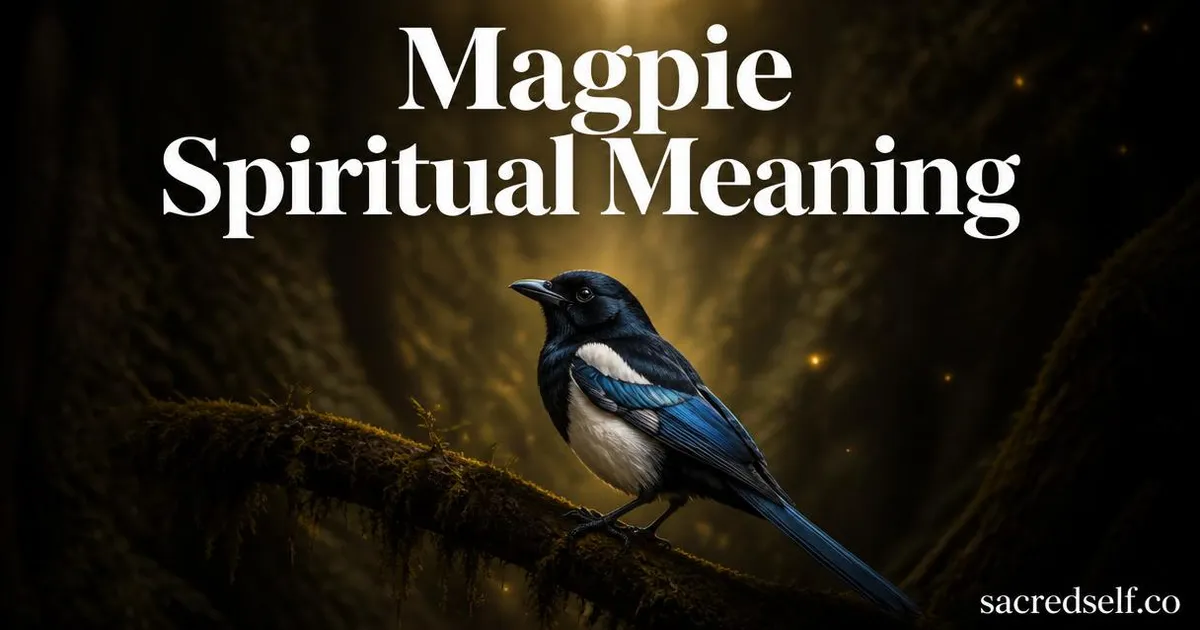
Magpies land somewhere between admired and mistrusted. In China, they’re symbols of joy and reunion. In Britain, a lone magpie prompts people to salute or mutter greetings to ward off sorrow. The same bird carries opposite meanings depending on where you’re standing.
This duality isn’t accidental. Magpies themselves are contradictions: intelligent yet opportunistic, loyal yet territorial, strikingly beautiful yet often unwelcome. They’re one of the few animals that recognize themselves in mirrors, yet folklore has cast them as thieves and omens for centuries.
What a magpie means to you depends on context: the number you saw, what was happening in your life at that moment, and which cultural stories you carry. There’s no single answer, but there are patterns worth exploring.
Key Takeaways
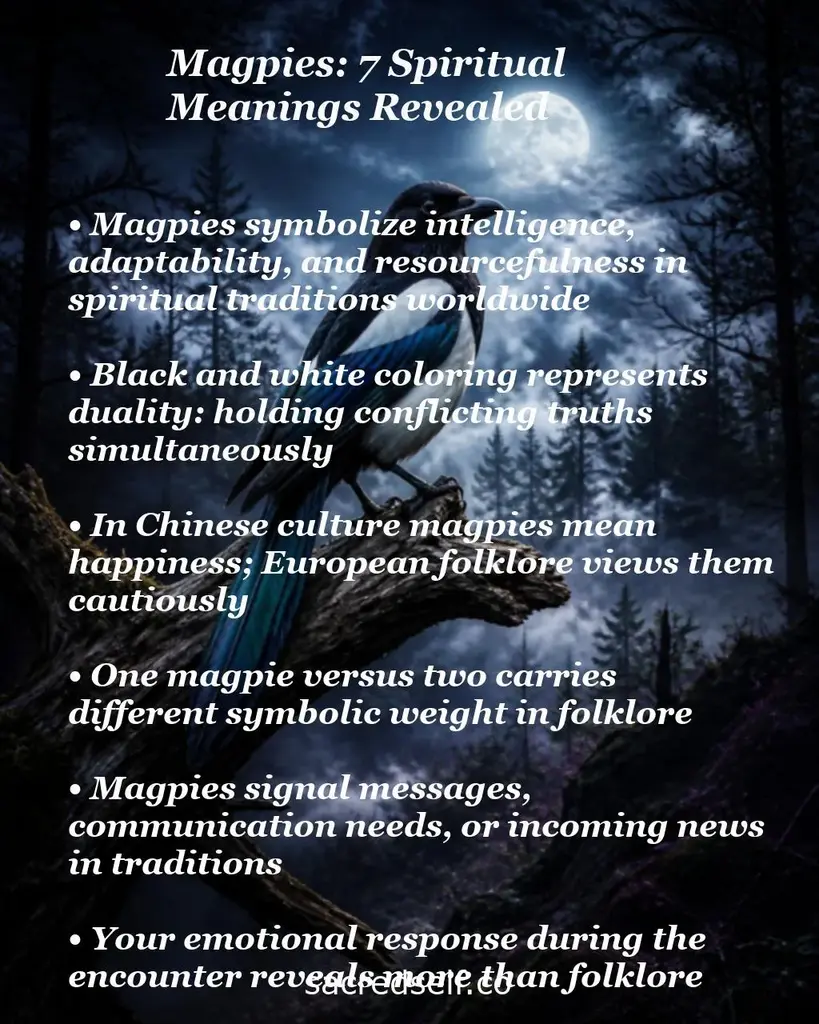
- Magpies symbolize intelligence, adaptability, and resourcefulness across many traditions
- Their black and white coloring represents duality: holding opposing truths at once
- They’re messengers in some cultures, connected to communication and incoming news
- Numbers matter: one magpie carries different associations than two or more
- Chinese traditions view magpies as symbols of happiness; European folklore is more cautious
- Your emotional response during the encounter matters more than any fixed interpretation
🦋 Readers often explore this next: Bluebird Spiritual Meaning
7 Spiritual Meanings of Magpies
Magpies appear in spiritual traditions as symbols of complexity. Here are seven interpretations that show up across cultures and personal experiences.
1. Intelligence and Problem-Solving
Magpies are among the smartest birds on the planet. They’re one of the few animals to pass the mirror test, recognizing their own reflection rather than treating it as another bird. This cognitive ability sets them apart.
Seeing a magpie might point to a time when you need to use your wit and cleverness. If you’re facing a complex situation or feeling stuck, the magpie reminds you that you’re capable of thinking outside conventional solutions.
Reflection: What problem in your life needs a creative approach? Where might you be overthinking instead of outsmarting?
2. Duality and Balance
The black and white plumage is hard to miss. It’s a visual metaphor for opposites existing together: light and shadow, joy and sorrow, truth and deception.
Magpies symbolize the ability to hold multiple truths at once. Life isn’t binary, and the magpie’s coloring reflects that complexity. You can be both grieving and hopeful. You can love someone and still need distance from them.
This meaning becomes relevant when you’re experiencing conflicting emotions, dealing with moral complexity, or integrating different parts of yourself that don’t seem to fit together neatly.
Reflection: What opposing forces are you balancing right now? Where do you need to make peace with contradiction?
3. Communication and Messages
Magpies are vocal, social birds with complex communication systems. They chatter, mimic, and maintain social bonds through sound.
In spiritual interpretation, they often represent incoming news, the need to speak up, or paying closer attention to what’s being said around you. If you’ve been waiting for important information or feeling unheard, a magpie might be relevant.
Practical step: Notice what you were thinking about when you saw the magpie. That thought might be the “message” worth examining.
4. Curiosity and Attraction to Shiny Things
Magpies are famous for collecting bright objects, though this trait is somewhat exaggerated in folklore. Still, they are curious and investigative, drawn to things that catch their eye.
This symbolizes what captures your attention: what you’re drawn to and why. It can represent distraction (chasing things that glitter but lack substance) or the search for value in unexpected places.
This meaning surfaces when you’re feeling scattered, questioning your priorities, or discovering new interests that pull you in different directions.
Reflection: What’s been catching your attention lately? Is it truly valuable or just shiny?
5. Adaptability and Survival
Magpies thrive almost anywhere. They live in forests, farmland, suburbs, and city centers. They’re opportunistic feeders who make the most of whatever’s available.
This adaptability makes them symbols of resourcefulness and resilience. When circumstances change, magpies adjust. They don’t wait for ideal conditions: they work with what they have.
If you’re facing change, needing to adapt to new circumstances, or making do with limited resources, the magpie offers a model for survival.
6. Territory and Boundaries
Magpies are fiercely protective of their space. During nesting season, they’ll swoop at perceived threats, including humans who get too close. They defend what’s theirs without hesitation.
This can symbolize the need to protect your energy, space, or values. Sometimes you need to be firm in setting boundaries, especially when something important is at stake.
This meaning becomes relevant when you’re feeling invaded, struggling to maintain boundaries, or needing to stand your ground on an issue that matters.
Reflection: Where do you need to be more protective? What’s worth defending in your life right now?
7. Partnership and Loyalty
Magpies often mate for life. Pairs work together to build nests, raise young, and defend territory. This partnership is cooperative and enduring.
Two magpies especially connect to themes of companionship, teamwork, and loyalty. In relationships (romantic, platonic, or professional), magpies represent the value of having a true partner.
This meaning shows up when you’re thinking about relationships, needing support, or recognizing who stands beside you when things get difficult.
Reflection: Who are your true partners? Where do you need collaboration instead of working alone?
How Numbers Change the Meaning
The number of magpies you see shifts the interpretation, especially in European folklore traditions.
One Magpie
The traditional rhyme says “one for sorrow,” but this isn’t a curse or prediction. It’s more about solitude, independence, or singular focus.
A single magpie can represent standing alone, individuality, or a reminder to check in with yourself. Some people salute or greet a lone magpie as a folk custom meant to acknowledge the encounter.
Context matters more than the rhyme. Were you feeling lonely when you saw it, or empowered? Your emotional state gives the sighting its personal meaning.
Two Magpies
The rhyme continues: “two for joy.” This is traditionally seen as a positive sign, connected to partnership, balance, and duality in harmony.
Two magpies often relate to relationships and collaboration. They can indicate reconciliation, the coming together of opposites, or confirmation that you’re not alone in something.
If you’re navigating a relationship or seeking connection, two magpies might feel particularly relevant.
Three or More Magpies
Three magpies traditionally connect to significant events or changes (“three for a girl, four for a boy” in some versions of the rhyme, though this is outdated and varies widely).
Groups of magpies suggest community, social dynamics, and collective energy. Rather than fixed meanings, notice patterns and social themes in your life when you see multiple magpies together.
Cultural and Spiritual Perspectives on Magpies
Magpie symbolism varies dramatically across cultures. Understanding these perspectives helps you decide which interpretations resonate with your own experience.
European Folklore and the Magpie Rhyme
The counting rhyme “One for sorrow, two for joy” originates in European folklore, with multiple regional versions. It treats magpies as omens tied to what’s coming, not warnings of what to fear.
Some traditions involve greeting magpies: saying “Good morning, Mr. Magpie” or saluting when you see one alone. These customs were meant to ward off bad luck or show respect.
These are cultural stories passed down through generations. They’re not universal spiritual laws, and you’re not obligated to follow superstitions that don’t feel relevant to you.
Biblical and Christian Interpretations
Magpies are not mentioned in the Bible directly. They don’t appear in scripture as symbols or in any biblical narrative.
Some Christian folklore associates them with the crucifixion: myths claim the magpie was the only bird that refused to mourn Christ’s death. Their black and white coloring has been interpreted as representing good versus evil in some traditions.
These are interpretations added over centuries of Christian culture, not biblical doctrine. If you’re looking for scriptural guidance, focus on principles about creation, discernment, and avoiding excessive reliance on omens (Deuteronomy 18:10-12 warns against divination).
Celtic and British Traditions
In Celtic folklore, magpies are associated with the Otherworld and supernatural communication. They’re seen as birds that move between realms: life and death, seen and unseen.
Some Celtic stories connect them to prophecy and foreknowledge. Traditional British culture treats them with a mix of respect and wariness, acknowledging their intelligence while maintaining superstitious caution.
East Asian Symbolism
In Chinese culture, magpies (喜鹊, xǐquè) are symbols of good fortune and happiness. The character 喜 means “joy,” and the bird is celebrated rather than feared.
Magpies are associated with the Qixi Festival, which celebrates the reunion of separated lovers. According to legend, magpies form a bridge across the Milky Way so two lovers can meet once a year.
This stands in stark contrast to European associations with sorrow. It’s a clear example of how culture shapes meaning: the same bird carries opposite messages depending on tradition.
Modern Spiritual Interpretations
Contemporary spirituality often focuses on magpie intelligence and adaptability rather than inherited superstitions. Modern interpretations emphasize personal meaning over cultural baggage.
Magpies appear as spirit animals for creatives, communicators, and collectors: people who gather information, make connections, and see value in what others overlook.
The emphasis is on what the magpie means to you, not what an old rhyme says you should feel.
🦋 If this resonated, you might also like: Spiritual Meaning Of Fox Crossing Your Path
Magpies in Specific Contexts
Certain encounters carry additional layers of meaning based on where or how you see the magpie.
Seeing a Magpie in Your House
Magpies don’t typically enter homes, so this is unusual behavior worth noting. Practically, check if something drew them in: an open window, food, or a shiny object.
Symbolically, a magpie inside your house could represent a message hitting close to home, a boundary crossing, or the need to address domestic matters. It brings magpie symbolism (communication, duality, intelligence) directly into your personal space.
Ask yourself: What home, family, or personal matter needs attention right now?
Magpie as a Spirit Animal
If magpies keep appearing in your life (repeatedly, across different contexts), they might function as a spirit animal for you.
Magpie traits include:
- Intelligence and problem-solving
- Communication and social connection
- Opportunism and resourcefulness
- Loyalty to partners and territory
- Territoriality and protective behavior
Shadow side:
- Tendency toward distraction (chasing shiny things)
- Reputation issues (being misunderstood or mistrusted)
- Protective behavior that pushes others away
Questions to consider: Do you identify with these qualities? Which ones are showing up in your life right now?
Dreaming of Magpies
Dreams amplify symbolic meanings through your subconscious. What the magpie was doing in the dream matters.
A talking magpie: Communication you need to hear or express. Pay attention to what it said or what you felt compelled to say back.
An aggressive magpie: Boundary issues or feeling attacked. Something in your waking life is threatening your sense of safety or territory.
A collecting magpie: Examine what you value or what you might be hoarding: objects, information, grievances.
Note how you felt in the dream. Your emotional response provides context for interpretation.
What Should You Do After Seeing a Magpie?
If you saw a magpie and felt it was significant, here’s how to work with that experience without forcing meaning or falling into anxiety.
Reflective Questions to Ask Yourself
- What was I thinking about right before I saw it?
- How did I feel during the encounter: curious, anxious, delighted, uneasy?
- What’s happening in my life right now that might connect to magpie symbolism?
- Am I looking for a sign, or did this genuinely feel significant on its own?
- Does the number of magpies reflect anything in my life (alone versus partnered, for example)?
Practical Steps for Interpretation
Journal about the encounter while the details are fresh. Write down what you saw, how you felt, and what you were thinking about.
Notice if magpies keep appearing. One sighting might just be coincidence, but repeated encounters suggest a pattern worth exploring.
Research what magpies mean in your own cultural background. Your heritage might carry specific stories or associations that resonate more than generic interpretations.
Trust your first instinct about what it meant to you. Your immediate reaction often carries more truth than what you convince yourself of later.
Don’t force meaning if it doesn’t feel relevant. Not every bird sighting is a message. Sometimes a magpie is just a magpie.
Moving Forward Without Anxiety
Seeing a magpie (even one alone) is not a curse or bad omen you need to fix. The “one for sorrow” rhyme is a cultural story, not a spiritual mandate.
You don’t need to perform rituals or “reverse” the sighting. If old superstitions don’t resonate with you, let them go.
If you feel drawn to acknowledge the encounter, simple recognition is enough. You can say a quiet “I see you” or take a moment to reflect.
The meaning you give the experience matters more than inherited folklore. You’re not bound by what people believed centuries ago in a different place.
🦋 Readers often explore this next: Spiritual Meaning Of Lady Bug
Frequently Asked Questions
What does seeing magpies mean spiritually?
Seeing a magpie can symbolize intelligence, duality, communication, or adaptability depending on context. Many people interpret them as signs to pay attention to messages, use your wit, or examine what you’re attracted to.
The meaning shifts based on cultural background, the number of magpies, and your personal circumstances when you saw them. If it felt significant, pay attention to what you were thinking about in that exact moment: that’s often where the real message lives.
Are magpies good omens?
It depends on cultural tradition. In Chinese culture, magpies are symbols of happiness and good fortune. In European folklore, they have mixed associations: sometimes linked to sorrow (especially one alone) and sometimes to joy (pairs).
Rather than being universally good or bad, magpies are complex symbols. Your own experience and cultural background shape whether you see them as positive. If you felt good when you saw it, trust that response over what an old rhyme says.
What does God say about magpies?
Magpies are not mentioned in the Bible. Some Christian folklore associates them with negative symbolism (myths about the crucifixion that aren’t found in scripture), but these are cultural additions, not biblical teaching.
If you’re looking for biblical guidance, focus on principles about creation (all birds are made by God), discernment, and not placing too much weight on omens. Deuteronomy 18:10-12 warns against divination, while Psalms celebrate all of creation as evidence of God’s work.
What is the significance of a single magpie?
Traditional European rhyme says “one for sorrow,” but this isn’t a literal prediction. A single magpie might symbolize independence, solitude, standing alone, or singular focus. Some people salute or greet a lone magpie as a folk custom.
The significance depends more on your emotional response and life context than the old rhyme. Were you feeling empowered or lonely when you saw it? That emotional state gives the encounter its personal meaning.
Is a magpie a bad omen?
Not inherently. While some European folklore treats magpies (especially single ones) with suspicion, other cultures see them as fortunate. Modern spiritual interpretation focuses on their intelligence and adaptability rather than superstitious omens.
If you’re worried after seeing a magpie, remember that old rhymes are cultural stories, not spiritual facts. Your response to the encounter matters more than inherited fear. If it brought up anxiety, ask yourself why: that might be the real message.
What is the old wives’ tale about magpie?
The most famous is the counting rhyme: “One for sorrow, two for joy, three for a girl, four for a boy” (versions vary by region). Other traditions include saluting or saying “Good morning, Mr. Magpie” when seeing one alone to ward off bad luck.
Some tales claim magpies are thieves attracted to shiny objects, which is partially true: they are curious birds. These are folk customs passed down through generations. They’re interesting cultural history, but they’re not universal truths you need to follow.
What does it mean when you see 2 magpies?
Two magpies traditionally symbolize joy, partnership, and good fortune (“two for joy” in the old rhyme). They can represent balance, companionship, or harmonious duality.
In terms of relationships, some people see two magpies as a positive sign for love and partnership. If you’re going through something with a partner or seeking connection, two magpies might feel particularly relevant. They’re a reminder that you don’t have to face everything alone.
What’s the spiritual meaning of seeing a magpie repeatedly?
Repeated sightings suggest paying closer attention to magpie symbolism in your life. It could mean you’re in a season requiring intelligence and adaptability, communication themes are prominent, you’re being asked to examine duality or balance, or you’re finally noticing something you previously overlooked.
Also consider the practical: magpies are territorial, so you might just be walking through their space regularly. But if the sightings feel meaningful, ask yourself which magpie quality (intelligence, partnership, adaptability, boundaries) is most relevant to your current situation.
Final Thoughts
Magpies carry multiple meanings across cultures: from intelligence and duality to messages and partnership. How you interpret them depends on context, cultural background, and personal resonance.
There’s no single “correct” meaning, and seeing a magpie (even one alone) isn’t something to fear. The old rhymes are cultural artifacts, not spiritual laws. Trust your own sense of what the encounter meant.
What quality of the magpie (intelligence, adaptability, boldness, partnership) feels most relevant to your life right now? What were you carrying in your thoughts when you saw it?
Have you had a meaningful magpie encounter? Share your experience in the comments: sometimes hearing others’ stories helps clarify our own.
Namaste. 🙏