Every culture that’s ever existed has tried to capture balance visually. Not because symbols have magical power, but because humans need visual shorthand for abstract ideas we’re trying to live by.
If you’re here, you might be looking for tattoo inspiration, trying to understand a symbol you’ve encountered, or searching for a concrete way to represent your own pursuit of equilibrium. Balance isn’t just philosophy: it’s something we’ve been drawing, carving, and meditating on for thousands of years.
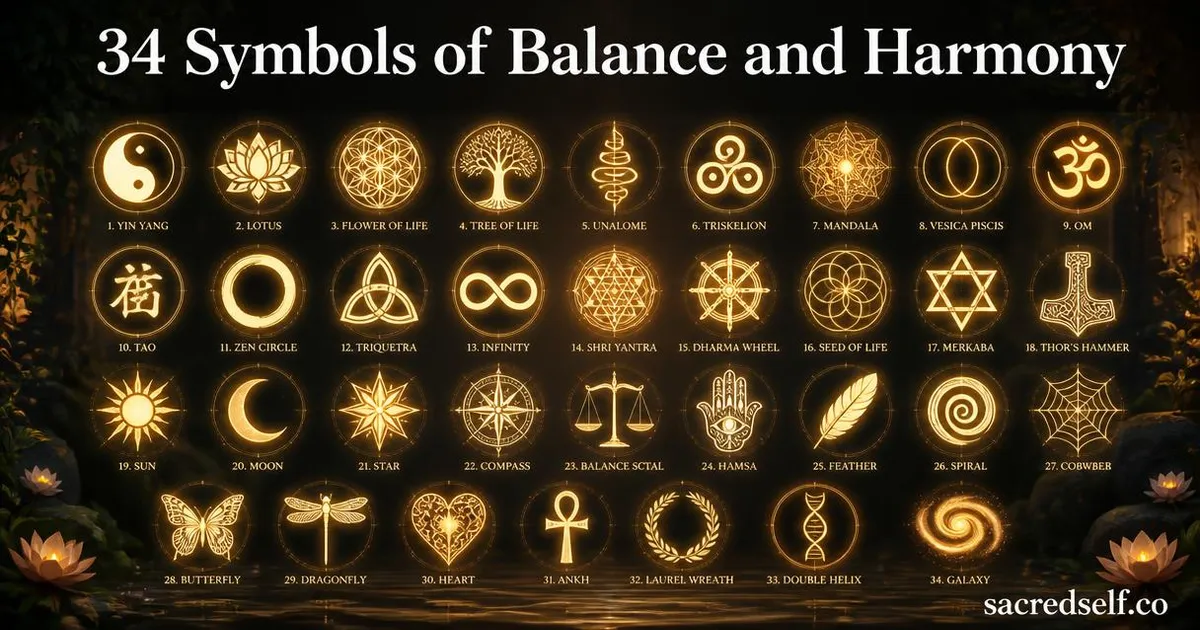
This article walks through 34 symbols from multiple traditions, explaining what each represents and why it connects to the idea of balance. Some focus on duality, others on cycles, and some on interconnection. What resonates depends on what kind of balance you’re seeking right now.
Key Takeaways
- Balance symbols appear across cultures because equilibrium is a universal human concern: internal, external, spiritual, and natural
- Some symbols focus on duality (yin yang, sun and moon), others on cyclical patterns (ouroboros, endless knot), and some on interconnection (tree of life, mandala)
- No single symbol is “the right one”: what resonates depends on what kind of balance you’re seeking or representing
- These aren’t magical objects. They’re visual reminders of principles you can apply to your own life
- Many symbols share common threads: cycles, symmetry, opposing forces working together, and the idea that everything affects everything else
🦋 Readers also searched for: Remedies For Blocked Chakras
34 Symbols of Balance and Harmony (And What They Mean)
Each symbol below represents a different angle on balance: some ancient, some modern, some culture-specific, some universal. Look for the ones that reflect what balance means to you right now.
1. Yin Yang
Origin: Ancient Chinese philosophy (Taoism)
What it represents: Complementary opposites that create wholeness: light and dark, masculine and feminine, active and receptive.
Why it resonates: Shows that balance doesn’t mean eliminating one side, but recognizing both are necessary. The dark contains a seed of light; the light contains a seed of dark. Neither is pure, and neither exists without the other.
Practical reflection: Where in your life do you resist one side of a natural duality?
2. Mandala
Origin: Hindu and Buddhist traditions, also appears in other cultures
What it represents: Spiritual and emotional wholeness radiating from a center point; the universe in miniature.
Why it resonates: The symmetrical design creates a sense of order and completeness. Everything has its place in relation to the center.
Practical reflection: Creating or coloring mandalas can be a meditative practice for finding your own center.
3. Tree of Life
Origin: Appears across traditions (Norse Yggdrasil, Kabbalah, Celtic, etc.)
What it represents: Interconnection between earth and sky, roots and branches, all parts of existence supporting each other.
Why it resonates: Reminds us that growth in one direction (branches) requires equal strength in another (roots). You can’t reach higher without being grounded deeper.
Practical reflection: Are you growing in a way that’s supported by your foundation?
4. Lotus Flower
Origin: Buddhism and Hinduism
What it represents: Beauty and purity emerging from muddy water; transformation and rising above difficulty while remaining rooted.
Why it resonates: Balance between being in challenging circumstances and not being defined by them. The lotus doesn’t deny the mud: it uses it.
Practical reflection: What difficult situation are you currently rooted in that might also be helping you grow?
5. Ouroboros
Origin: Ancient Egypt and Greece, appears in many cultures
What it represents: A serpent eating its own tail; cycles of destruction and creation, death and rebirth, endings that are also beginnings.
Why it resonates: Reminds us that life moves in cycles, not straight lines. What looks like an ending is also a beginning.
Practical reflection: What cycle are you currently in, and what phase of that cycle are you resisting?
6. Infinity Symbol (Lemniscate)
Origin: Mathematical symbol adopted for spiritual meaning
What it represents: Continuity without end, eternal flow, balanced energy moving in figure-eight pattern.
Why it resonates: Suggests balance isn’t a fixed point but a continuous flow between two poles. You’re never done: you’re always adjusting.
Practical reflection: Where are you trying to “arrive” instead of allowing natural flow?
7. Endless Knot (Eternal Knot)
Origin: Buddhism and Celtic traditions
What it represents: Interconnection of all things, no beginning or end, cause and effect woven together.
Why it resonates: Shows that nothing exists in isolation: everything affects everything. Pull one thread and the whole pattern shifts.
Practical reflection: How are different areas of your life affecting each other in ways you haven’t acknowledged?
8. The Five Elements
Origin: Chinese philosophy (Wood, Fire, Earth, Metal, Water) and other traditions have similar systems
What it represents: Natural forces that interact, support, and control each other in cycles.
Why it resonates: Shows balance as a system of relationships, not just two opposing forces. Too much fire needs water; too much metal needs wood to soften it.
Practical reflection: Which “element” or aspect of life are you overemphasizing or neglecting?
9. Sun and Moon
Origin: Universal across cultures
What it represents: Day and night, masculine and feminine, conscious and unconscious, outward energy and inward reflection.
Why it resonates: Natural, observable example of two forces alternating to create wholeness. You can’t have constant day without burning out.
Practical reflection: Are you honoring both your active and receptive sides?
10. Double Spiral
Origin: Ancient Celtic and other cultures
What it represents: Two forces moving in opposite directions but creating a balanced whole; expansion and contraction.
Why it resonates: Shows that opposing movements can exist simultaneously without canceling each other out. You can be building something new while letting something old go.
Practical reflection: What are you simultaneously building and releasing right now?
11. Six-Pointed Star (Hexagram/Shatkona)
Origin: Judaism (Star of David), Hinduism (Shatkona), sacred geometry
What it represents: Two triangles: one pointing up (reaching toward divine/spiritual), one pointing down (grounded in earth/material).
Why it resonates: Perfect symmetry between spiritual aspiration and earthly presence. Neither is more important; both create the whole.
Practical reflection: Are you balanced between your spiritual life and practical responsibilities?
12. Dharma Chakra (Wheel of Dharma)
Origin: Buddhism
What it represents: The Buddha’s teachings; eight spokes representing the Eightfold Path; cyclical nature of existence.
Why it resonates: Balance isn’t one thing: it’s eight interconnected practices working together. Right speech, right action, right livelihood, right effort, and so on.
Practical reflection: Which aspect of balanced living needs attention right now?
13. Cosmos Flower (Cosmea)
Origin: Symbolic meaning derived from the flower’s name and appearance
What it represents: Order and harmony in nature; petals arranged in perfect symmetry.
Why it resonates: Simple, natural example of balance that requires no effort: it just is. The flower doesn’t try to be symmetrical.
Practical reflection: Where are you forcing balance instead of allowing it to emerge naturally?
14. Equilateral Triangle
Origin: Sacred geometry, appears in many traditions
What it represents: Three equal sides creating stability; trinity concepts (body-mind-spirit, past-present-future).
Why it resonates: The most stable shape: balance through three points rather than two opposing forces. A triangle doesn’t tip.
Practical reflection: What third element are you missing that would stabilize two opposing aspects of your life?
15. Bonsai Tree
Origin: Japanese cultivation practice
What it represents: Nature shaped by intention; balance between control and allowing; patience and care.
Why it resonates: Living symbol of the ongoing practice of maintaining balance: it’s never “done.” You tend to it continuously.
Practical reflection: What in your life requires ongoing attention rather than a one-time fix?
16. Unicursal Hexagram
Origin: Western occultism, sacred geometry
What it represents: Six-pointed star drawn in one continuous line; unity within duality.
Why it resonates: Shows that opposing forces are actually part of one continuous path. The line never breaks: it just moves through different positions.
Practical reflection: What do you see as separate that might actually be connected?
17. Vesica Piscis
Origin: Sacred geometry, early Christian symbolism
What it represents: Two circles overlapping; the intersection where two separate things create something new.
Why it resonates: Balance isn’t choosing one or the other: it’s the space where both exist together. The overlap is where creation happens.
Practical reflection: What overlap between two parts of your life are you not fully exploring?
18. Seed of Life
Origin: Sacred geometry, appears in ancient temples worldwide
What it represents: Seven circles in a symmetrical pattern; the foundation from which more complex patterns emerge.
Why it resonates: Shows balance as the starting point for all creation and growth. Without this foundation, more complex patterns collapse.
Practical reflection: What foundational balance do you need to establish before expanding further?
19. Platonic Solids
Origin: Ancient Greek geometry (attributed to Plato)
What it represents: Five three-dimensional shapes with perfect symmetry; building blocks of reality.
Why it resonates: Mathematical proof that perfect balance exists in nature’s structure. The tetrahedron, cube, octahedron, dodecahedron, and icosahedron all have equal faces and angles.
Practical reflection: Where are you looking for balance in the wrong dimension: trying to solve a three-dimensional problem in two dimensions?
20. Lakota Triangle
Origin: Native American (Lakota) tradition
What it represents: Connection between earth, sky, and the individual; three aspects in harmony.
Why it resonates: Specific cultural expression of balance that includes your relationship to place and cosmos. You’re not separate from the world around you.
Practical reflection: How does your sense of balance include (or exclude) your relationship with the natural world?
21. Celtic Cross
Origin: Celtic Christianity
What it represents: Circle (eternity, wholeness) intersecting with cross (four directions, cardinal points, material world).
Why it resonates: Spiritual and earthly existence held in balanced relationship. The circle contains the cross; the cross gives the circle structure.
Practical reflection: How do you hold your spiritual beliefs alongside everyday practical concerns?
22. Eight-Pointed Star
Origin: Appears in Islamic art, sacred geometry, various traditions
What it represents: Eight directions, eight-fold paths, balance in all directions (not just two opposing forces).
Why it resonates: Suggests that balance involves many factors, not just one duality. Life pulls you in multiple directions simultaneously.
Practical reflection: What additional factors (beyond the obvious two) are affecting your sense of balance?
23. Squared Circle
Origin: Alchemy, sacred geometry
What it represents: Circle (spirit, heaven, infinite) contained within or containing a square (matter, earth, finite).
Why it resonates: The challenge of balancing the infinite with the finite, the spiritual with the practical. How do you fit boundless spirit into a bounded life?
Practical reflection: Where are you trying to contain something infinite in a finite space, or vice versa?
24. Celtic Five-Fold Knot
Origin: Celtic tradition
What it represents: Four outer elements or directions balanced by a center; the self in relationship to the world.
Why it resonates: You are the fifth element: balance requires your active participation. You’re not just observing; you’re part of the system.
Practical reflection: Are you seeing balance as something external, or as something you’re part of creating?
25. Twin Koi Fish
Origin: Japanese and Chinese symbolism
What it represents: Two fish swimming in opposite directions (often one black, one white or red); yin and yang in motion; partnership and duality.
Why it resonates: Balance between two forces moving in their own directions but remaining together. They don’t have to swim the same way to be in harmony.
Practical reflection: Where do you need to allow both independence and togetherness?
26. Number 2
Origin: Numerology across cultures
What it represents: Duality, partnership, the first division from oneness; balance between self and other.
Why it resonates: The simplest expression of balance: two equal forces. One is unity; two is the first relationship.
Practical reflection: What relationship in your life needs rebalancing between give and take?
27. Shri Yantra
Origin: Hindu Tantra
What it represents: Nine interlocking triangles radiating from a central point; the cosmos and human body as reflections of each other.
Why it resonates: Extremely complex symmetry showing that balance can include many layers and dimensions. Not everything is simple duality.
Practical reflection: What complex system in your life needs balancing, not just one simple adjustment?
28. Scales (Balance Scale)
Origin: Ancient symbol, associated with justice (Egyptian Ma’at, Greek Themis)
What it represents: Literal weighing of two sides to determine equality; fairness and justice.
Why it resonates: The most direct visual representation of balance: equal weight on both sides. In ancient Egypt, Ma’at weighed the heart against a feather to determine truth.
Practical reflection: What needs to be weighed more carefully in your life? What’s tipping the scales?
29. Caduceus
Origin: Greek (staff of Hermes), often confused with Rod of Asclepius
What it represents: Two serpents intertwined around a central staff with wings; opposing forces spiraling around a balanced center.
Why it resonates: Shows balance as two forces in tension, held by a stable center. The staff doesn’t move; the serpents spiral around it.
Practical reflection: What stable “center” can you return to when opposing forces feel chaotic?
30. Taijitu (Alternative Yin Yang Designs)
Origin: Chinese philosophy, variations of the standard yin yang
What it represents: Different cultural expressions of complementary duality. Some use three or four parts instead of two.
Why it resonates: Shows that the principle of balanced opposites can be expressed in multiple ways. There’s no single “correct” version.
Practical reflection: What cultural or personal lens do you view balance through?
31. Four Directions Medicine Wheel
Origin: Various Native American traditions
What it represents: Four cardinal directions, four seasons, four life stages: all balanced around a center.
Why it resonates: Balance as honoring all phases and directions equally. Each has its purpose; each deserves attention.
Practical reflection: Which direction or phase of life are you honoring, and which are you neglecting?
32. Hourglass
Origin: Timekeeping device adopted as symbol
What it represents: Time flowing from one chamber to another; the balance point between past and future.
Why it resonates: Reminds us that balance includes the dimension of time: neither rushing nor stagnating. The narrow middle is the present moment.
Practical reflection: Are you living too much in past or future, neglecting the present balance point?
33. Tetrahedron
Origin: Sacred geometry, Platonic solid
What it represents: Four-sided pyramid; fire element; balance in three-dimensional space with equal triangular faces.
Why it resonates: The simplest three-dimensional expression of balance: stable on any side. It doesn’t matter which face is down; it holds.
Practical reflection: What would it look like for you to be “stable” from any angle, not just one perspective?
34. Hamsa (Hand of Fatima/Hand of Miriam)
Origin: Middle Eastern and North African cultures (Islamic and Jewish)
What it represents: Symmetrical hand; protection and balance; five fingers representing five pillars or five senses.
Why it resonates: Balance includes protection: not letting too much in or keeping too much out. The hand both receives and shields.
Practical reflection: Where do you need better boundaries to maintain balance?
What Makes a Symbol “Balanced”? (Common Threads)
If you look at the symbols above, patterns emerge. They aren’t arbitrary designs: they reflect principles we observe in nature and human experience.
Balanced symbols often include two opposing forces that complement rather than fight. Light and dark, up and down, expansion and contraction. Not enemies, but partners. Many feature circular or cyclical patterns with no fixed beginning or end. The ouroboros, endless knot, infinity symbol, and Dharma Wheel all show that balance isn’t a destination you reach and stay at: it’s continuous movement.
Symmetry appears frequently: equal visual weight on all sides, equal spacing, mirror images. Your eye knows when something is balanced because it feels stable, complete.
Most have a center point from which everything radiates or around which everything revolves. The mandala, medicine wheel, Shri Yantra, and five-fold knot all show this: balance requires a stable center.
When looking for or creating your own balance symbol, these patterns can guide you. What’s the center? What are the opposing or complementary forces? Does it suggest movement or stability? Cycles or fixed points?
Cultural and Spiritual Perspectives on Balance Symbols
Different traditions emphasize different aspects of balance.
Eastern Philosophy (Taoism, Buddhism, Hinduism)
In Taoism, balance comes through wu wei: effortless action, not forcing. You follow the Tao (the way) rather than fighting against it. Yin and yang aren’t just complementary: they’re fundamental to existence itself. Everything contains both.
Buddhism teaches the Middle Way between extremes. Not indulgence or denial, but the path between. The Dharma Wheel represents balanced practice across eight areas. Mandalas serve as tools for achieving mental and spiritual balance through meditation.
Hinduism explores balance of energies: Shiva and Shakti, masculine and feminine divine. The Shatkona (six-pointed star) shows these forces in perfect geometric balance. The Shri Yantra represents cosmic balance in its most complex form.
These traditions often emphasize balance as the natural state we return to, not something we force into existence. You don’t create balance; you stop creating imbalance.
Indigenous and Earth-Based Traditions
Native American traditions use medicine wheels to represent balance across four directions and four seasons. Balance isn’t just internal: it’s your relationship with the natural world and the cycles around you.
Celtic traditions use knotwork to show interconnection, spirals to represent life cycles. They emphasize threshold times: dawn and dusk, equinoxes, when opposing forces meet.
These traditions teach balance with nature rather than over it. You’re part of the ecosystem, not separate from it. Your balance affects and is affected by everything around you.
Western and Abrahamic Traditions
In Judaism, the Star of David represents balance between God and humanity, heaven and earth. The Menorah’s seven branches arrange symmetrically around a center.
Christianity uses the Celtic Cross to show spiritual and material intersection. The Trinity represents balance of three aspects: Father, Son, Holy Spirit, as one unified whole.
Islam emphasizes balance (mizan) as a divine principle. Eight-pointed stars in sacred geometry and mosque decoration reflect this. Everything has its proper measure and place.
Greek philosophy introduced the Golden Mean: neither excess nor deficiency. The scales of justice (Themis) represent balanced judgment.
These traditions often frame balance as moral and ethical principle, not just aesthetic or philosophical. How you live matters; balance is rightness.
Alchemical and Esoteric Traditions
Alchemy uses the squared circle to represent spirit and matter in balance. Solve et coagula (dissolve and coagulate) shows the need to balance breaking down and building up.
Sacred geometry sees mathematical precision underlying all visual balance. Shapes aren’t decorative: they’re fundamental patterns of creation. The Platonic solids, Seed of Life, and Vesica Piscis all express this.
These traditions approach balance as formula or recipe.
🦋 Our readers also explored: Heart Chakra Affirmations
How to Use Balance Symbols in Your Life
Symbols don’t create balance on their own. They’re tools for attention and intention.
As Visual Reminders
Place symbols where you’ll see them during moments when you need to remember balance. Your desk, phone background, mirror, car dashboard.
Let the symbol serve as a pause button: a moment to check in with yourself. Just a cue to ask: “What needs attention right now?”
You don’t need to “believe in” a symbol for it to function as an anchor. It’s visual shorthand for an idea you’re already working with.
As Meditation or Reflection Tools
Mandalas work well for coloring or gazing meditation. The symmetry calms the mind and brings attention to center.
Drawing your own version of a balance symbol makes the practice active. Your hand learns the pattern; your mind follows.
Use the symbol as a focus point while considering what balance means for you right now. Not in general: today, this week, in this situation.
As Decision-Making Frameworks
When facing a choice, consider: “Which option creates more balance?” Not necessarily the easier one, but the one that evens things out.
Use specific symbols’ meanings to evaluate situations. Does this honor both the sun and moon sides of my life? Is this allowing natural cycles like the ouroboros? Does this strengthen my roots as well as my branches?
The symbol becomes a lens for seeing your situation from a different angle.
As Personal Symbols (Jewelry, Tattoos, Art)
If you’re drawn to a particular symbol, consider what aspect of balance it represents and why that resonates right now.
Personal symbols work best when you understand their meaning, not just their aesthetic. A tattoo you can explain matters more than one that just looks good.
Remember: the symbol doesn’t create balance. It represents your commitment to it. You’re the one doing the work.
Practical Steps for Finding Your Own Balance
Symbols point the way, but you have to walk it.
Identify what’s out of balance: Use the symbols as a framework. Is it a duality issue (yin/yang)? A cyclical issue (ouroboros)? An interconnection issue (tree of life)? Naming the type of imbalance helps you address it.
Look at what you’re overemphasizing and underemphasizing: Balance isn’t about perfect 50/50 every day, but about cycles that average out over time. If you’ve been all action, rest might restore balance even if it feels lopsided in the moment.
Consider the dimension of balance you need: Physical? Emotional? Relational? Spiritual? Time-based? Work-life? You might be balanced in one area and completely off in another.
Start with small adjustments: If you’re all “sun” energy, add one “moon” practice. If you’re stuck in one season, ask what the next phase requires. Don’t overhaul everything at once: that’s often another form of imbalance.
Recognize that balance is dynamic, not static: What feels balanced will shift with circumstances and life stages. Balance with a newborn looks different from balance as an empty-nester. Both are valid.
Check in regularly: Use your chosen symbol as a prompt. Once a week, once a month: whatever rhythm works. Ask: “What needs rebalancing right now?” The answer changes.
Frequently Asked Questions
What is a symbolic symbol for harmony?
Several symbols represent harmony specifically. The endless knot shows all things working together in interconnected relationship. Mandalas represent inner harmony radiating from a centered state. The cosmos flower demonstrates natural symmetry. The yin yang shows harmonious opposites.
Harmony emphasizes things working together, while balance emphasizes equal weight or cycles. Many symbols represent both: harmony often requires balance, and balance often creates harmony.
What are some symbols that represent balance?
The most recognized are the yin yang (complementary opposites), scales (equal weight), tree of life (balanced growth upward and downward), infinity symbol (continuous flow), and ouroboros (cyclical balance).
Each focuses on a different aspect. The yin yang emphasizes duality. The scales emphasize equality. The tree emphasizes interconnection. The infinity symbol emphasizes flow. The ouroboros emphasizes cycles. Choose based on what kind of balance you’re exploring.
What symbolizes balance in nature?
Trees show balance through roots and branches, through seasonal cycles of growth and rest. Lotus flowers root in mud but bloom above water. Sun and moon alternate in day and night cycles. Koi fish swim in complementary directions. Bonsai trees demonstrate cultivation and nature working together.
Nature provides constant examples of dynamic balance. Survival depends on it: too much of anything and the system collapses.
What is the ancient symbol of balance?
The yin yang is perhaps the most ancient and widely recognized, originating in Chinese philosophy thousands of years ago. The scales appear in ancient Egypt, where Ma’at’s scales weighed the heart against a feather. Six-pointed stars appear across ancient cultures. The ouroboros dates to ancient Egypt and Greece.
“Ancient” doesn’t mean more powerful: it means the idea has been useful for a long time. Humans have been working on balance since we’ve been human.
What symbolizes balance and harmony together?
The endless knot shows balance of all interconnected things working in harmony. Mandalas represent harmonious symmetry radiating from a balanced center. The Shri Yantra displays complex balanced geometry creating harmony. The tree of life shows all parts supporting each other. The Dharma Wheel represents the balanced path that creates harmony.
Symbols that show interconnection tend to represent both balance and harmony. They demonstrate that when things are in right relationship, harmony emerges.
What is the Greek symbol for balance?
The scales, associated with Themis (goddess of justice), represent balanced judgment. The ouroboros (serpent eating its tail) shows cyclical balance. The caduceus (Hermes’ staff with intertwined serpents) depicts opposing forces spiraling around a balanced center.
Greek philosophy emphasized “the Golden Mean”: balance between extremes. Neither too much nor too little, but the right amount for the situation.
What is the Buddhist symbol for balance?
The Dharma Wheel represents the Eightfold Path: eight aspects of balanced living. The endless knot shows interconnection and the balance of cause and effect. The lotus flower represents being in difficulty without being consumed by it. Mandalas serve as visual representations of balanced cosmos.
Buddhism calls balance “the Middle Way”: avoiding extremes of indulgence and denial. Not punishing yourself, not overindulging, but walking the path between.
Who is the Greek god of balance?
Themis is the goddess of divine order and justice, often depicted with scales. Her daughter Dike also represented justice and fair judgment.
Also relevant: Harmonia (goddess of harmony and concord), and the concept of Moira (fate, balance, portion): the idea that everything has its proper measure.
What is the symbol of peace and balance?
The yin yang represents peaceful coexistence of opposites. The dove symbolizes peace (though not specifically balance). The olive branch represents peace offering. The infinity symbol suggests endless peaceful flow.
Peace often requires balance: conflict arises when things are lopsided, when one side dominates. Balance creates the conditions for peace.
Can I create my own balance symbol?
Yes. Many people do, especially if existing symbols don’t capture what balance means for them personally.
Consider what balance looks like in your life. Is it two things? Three? A cycle? A center with things radiating out? Is it symmetrical or does it flow?
Draw or visualize it. The process itself is valuable: it forces you to define what you mean by balance, which is half the work.
Does wearing a balance symbol actually create balance?
The symbol itself doesn’t create balance: you do. It’s not a magic charm.
However, it can serve as a reminder, a touchstone when you notice yourself touching or seeing it, and a physical representation of your intention. That has real value.
Think of it as a bookmark rather than the book itself. It marks your place; it doesn’t tell the story.
🦋 Readers also searched for: Sun And Moon Together Spiritual Meaning
Final Thoughts
Balance isn’t a destination you reach and stay at. It’s something you notice, adjust, and revisit throughout your life.
These symbols are maps left by people who were working on the same thing you are. They don’t prescribe answers, but they can help you ask better questions. What are the opposing forces in your life? What’s the center you return to? What cycle are you in?
You don’t need to master all 34 symbols or find the “right” one. Even noticing what feels unbalanced is progress. Even asking “what kind of balance do I need?” moves you forward.
Which symbol caught your attention as you read this? What might that say about what you’re currently working on? What would your own balance symbol look like if you drew it today?
Share your experience in the comments: which symbol resonates with where you are right now, or has a symbol helped you notice something about your life?
Namaste. 🙏