Opalite isn’t a crystal. It’s glass: synthetic, human-made, manufactured to mimic the iridescent glow of opal and moonstone. That fact alone makes some people dismiss it entirely, while others find it just as meaningful as anything pulled from the earth.
The question isn’t whether opalite is “real” in the geological sense. It’s whether it resonates with you, whether it serves a purpose in your spiritual practice, and whether the intention you bring to it matters more than its origin story.
This article explores how people work with opalite spiritually, the benefits commonly associated with it, and how to decide if it has a place in your life, regardless of where it came from.
Key Takeaways
- Opalite is man-made glass, not a natural crystal – created to resemble opal and moonstone with a milky, iridescent appearance
- People connect it with emotional balance, clearer communication, navigating transitions, and spiritual awareness
- Commonly linked to the third eye and crown chakras, supporting intuition and higher consciousness
- Used in meditation, energy work, daily carry, or kept nearby as a calming presence
- Whether it “works” depends entirely on your personal experience and the intention you bring to it
🦋 Continue your journey with: Remedies For Blocked Chakras
What Is Opalite?
Opalite is synthetic opalescent glass. You’ll sometimes see it labeled as Tiffany stone or sea opal, though those names can be misleading – they sound natural, but the material isn’t.
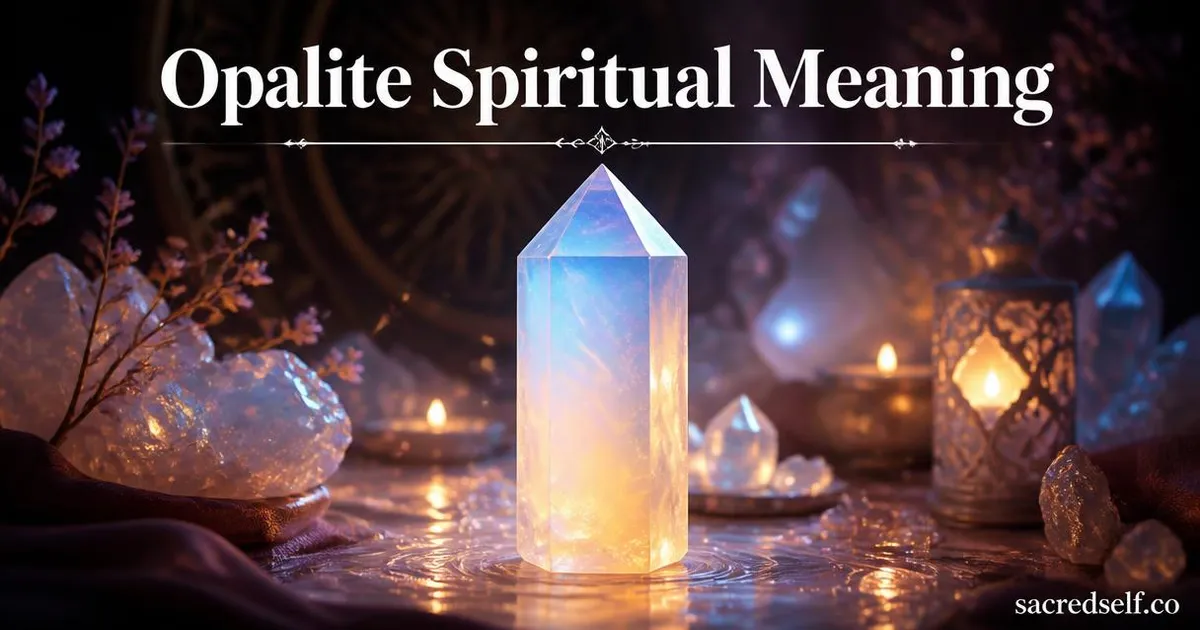
It has a milky, translucent base that shifts between blue and golden iridescence depending on the light. Hold it up to a window and it glows orange or amber. Set it against a dark background and it flashes blue.
Opal, by contrast, is a mineraloid that forms naturally over thousands of years. It contains water and silica, develops in the earth’s crust, and costs significantly more. Opalite is manufactured, affordable, and widely available.
Some people care deeply about this distinction. They believe natural stones carry energy shaped by geological time, and that synthetic materials don’t hold the same resonance. Others find that intention matters more than origin – that what you bring to an object shapes its role in your life.
Neither perspective is wrong. The question is what feels true for you.
Spiritual Meaning and Metaphysical Properties of Opalite
Opalite is most often associated with transition and change. People reach for it when they’re navigating uncertainty – ending a relationship, starting a new job, moving cities, or simply feeling untethered. It’s thought to ease the discomfort of in-between spaces, offering a sense of stability when the ground feels unsteady.
Many connect it with communication and self-expression. If you’ve been holding back something you need to say, or struggling to find words for a difficult conversation, opalite is believed to support clearer speech and honest dialogue. It’s used when vulnerability feels risky but necessary.
Emotional balance is another common theme. Some people find it calming during anxious or overwhelming periods, describing it as a way to steady their mood or soften reactivity. It doesn’t erase feelings – it creates space to feel them without drowning.
Opalite is also linked to spiritual connection and intuition. It’s thought to open awareness, deepen meditation, or help you feel more attuned to inner guidance. For some, it’s a tool for accessing insight that logic alone can’t reach.
Benefits of Opalite (Health, Emotional, Spiritual)
Opalite’s reported benefits span emotional, spiritual, and physical realms. Here’s what people commonly experience when working with it.
Metaphysical and Emotional Benefits
People report feeling more centered and less reactive when working with opalite. It’s described as a steadying presence during emotional turbulence – not numbing, but grounding.
Some use it as a touchstone for self-worth and confidence, especially during moments when they need to remember their own value. Holding it becomes a physical reminder: you matter, your voice matters, your boundaries matter.
Opalite is thought to encourage openness in relationships. It’s believed to soften defensiveness and invite honest dialogue, making it easier to say what needs to be said or hear what needs to be heard.
During moments of confusion or indecision, some people hold opalite to clarify their thoughts. It’s not about getting answers handed to you – it’s about creating mental space so the answer you already know can surface.
Physical Health Associations (Disclaimer Needed)
Some sources mention opalite being used for fatigue, sleep issues, or supporting the body during hormonal transitions. These are folk uses and metaphysical beliefs, not medical claims.
Crystal work – synthetic or natural – is never a substitute for professional healthcare. If something feels physically wrong, consult a doctor first. Opalite can be part of a broader self-care practice, but it’s not medicine.
Spiritual and Energetic Benefits
Many find opalite’s appearance visually calming, which helps settle into a meditative state. The iridescence creates a focal point, something beautiful to rest your attention on when your mind won’t quiet.
It’s commonly used in chakra work, particularly with the third eye (intuition, insight) and crown (spiritual connection) chakras. Some people place it on these areas during meditation or energy work.
Opalite is also associated with energy clearing: releasing old patterns, letting go of stagnant energy, or marking the end of a chapter. This varies by person. You’ll know if it’s working by how you feel, not by any external measure.
🦋 You might also be interested in: Agate Spiritual Meaning
Opalite and the Chakras
Opalite is most often linked to the third eye chakra, located between the eyebrows. This chakra governs intuition, inner vision, and the ability to see beyond surface appearances. Opalite is thought to support openness here, making it easier to trust your instincts or access deeper understanding.
The crown chakra is another common association. Positioned at the top of the head, this energy center connects to spiritual awareness, higher consciousness, and the feeling of being part of something larger. Working with opalite here is believed to invite clarity and connection.
Some practitioners include the throat chakra due to opalite’s communication themes. If you struggle to speak your truth or feel silenced in some area of your life, placing opalite near your throat during meditation might help open that pathway.
How to work with it: place the stone on the corresponding area during meditation, hold it while reflecting on a specific intention, or simply keep it nearby as a visual and energetic anchor. Trust your own sense of what feels right – if placing opalite somewhere other than these traditional spots feels more aligned, follow that instinct.
Opalite in Spiritual Practices
How to Use Opalite
Meditation: Hold opalite in your hand, place it on your body (forehead, heart, throat), or set it in your line of sight as a focal point. Let its iridescence anchor your attention.
Daily carry: Keep it in a pocket, bag, or bra as a reminder of an intention – calm, clarity, courage to speak up, trust in the process.
Placement in space: Some people place opalite on a desk, nightstand, or altar as a visual anchor. It becomes a symbol of what they’re working toward or trying to remember.
Pairing with other stones: Opalite works well with amethyst (intuition), clear quartz (amplification), or rose quartz (emotional openness). Combine them if layering intentions feels right.
Rituals and intention-setting: Use opalite during new moon ceremonies or transitional moments to mark a shift or set a focus. Hold it while stating your intention aloud, then place it somewhere you’ll see it daily.
How to Charge and Cleanse Opalite
Moonlight is a popular method. Place opalite outside or on a windowsill overnight, especially during a full moon. Many find this symbolically fitting given the stone’s lunar appearance.
Sunlight works for brief exposure, though prolonged sun may affect its color over time. Use your judgment based on how much you care about preserving its exact appearance.
Sound can reset its energy. Use a singing bowl, bell, or tuning fork near the stone, letting the vibrations wash over it.
Smoke is another option if it’s part of your practice. Pass opalite through sage, palo santo, or incense with the intention of clearing it.
Intention alone can be enough. Hold the stone, mentally clear it, and reset it to your current purpose. The ritual is more about your focus than a fixed method.
Note: Since opalite is glass, avoid water if you’re unsure about temperature shock or surface treatment. Glass can crack or chip with sudden temperature changes.
🦋 You may also find insight in: Heart Chakra Affirmations
Opalite and Zodiac/Planetary Associations
Some sources link opalite to Cancer (emotional depth, intuition, sensitivity) or Pisces (spirituality, dreaminess, fluidity). Both are water signs, which aligns with opalite’s associations with emotion and inner life.
Planetarily, opalite is often connected to the Moon. This reflects its appearance – milky, glowing, reflective – and its themes of cycles, transitions, intuition, and the hidden emotional world.
These are interpretive frameworks, not rules. Use them if they add meaning to your practice. Ignore them if they don’t. You don’t need to match your sun sign to benefit from working with opalite.
Opalite in Witchcraft and Energy Work
Opalite is used in spells and rituals focused on new beginnings, communication, emotional healing, or spiritual opening. Its associations with transition make it a natural fit for marking endings and inviting fresh starts.
Some practitioners use it for divination, scrying, or dreamwork. Its reflective, luminous quality makes it a tool for gazing – either literally (staring into its surface to access intuition) or symbolically (holding it while seeking answers in dreams or meditation).
Protection is occasionally mentioned. Some believe opalite offers energetic shielding during vulnerable times or spiritual exploration – not a literal barrier, but a supportive presence that helps you stay grounded.
In shadow work, opalite’s association with bringing hidden things to light makes it a tool for exploring difficult emotions or patterns. If you’re working to understand why you react a certain way or what’s driving a repeating struggle, holding opalite can create space for that inquiry.
These uses are based on personal and traditional practice, not universal truth. Adapt them to what feels authentic to you. Magic and energy work are co-created – you bring the intention, the tool holds the focus.
Color Variations: White Opalite and Green Opalite
White Opalite
This is the most common form: milky white with a blue flash when backlit. It’s what most people mean when they say “opalite.”
Purity, clarity, fresh starts, and spiritual connection are emphasized with white opalite. It’s often used when someone wants to clear mental fog, reset their energy, or begin something new with intention.
Green Opalite
Less common, green opalite has a greenish tint and similar iridescence. It’s associated with the heart chakra, emotional healing, growth, and renewal.
People use green opalite when focusing on relationships, self-love, or releasing old emotional wounds. It’s thought to support forgiveness – of others and yourself – and to invite emotional expansion.
Note: Verify what you’re actually getting. “Green opalite” can sometimes refer to different materials entirely, or to opalite that’s been tinted or treated. Ask the seller if you’re unsure.
What to Reflect On
What drew you to opalite in the first place? Was it the appearance, a specific feeling when you held it, or something you read that resonated?
Is there a transition or shift happening in your life right now – something ending, beginning, or stuck in flux? Opalite’s associations with change aren’t random. People tend to reach for it when they’re in motion, even if they’re not sure where they’re headed.
Are there things you’ve been meaning to say but haven’t found the words or courage for? Opalite won’t speak for you, but it might remind you that your voice matters.
Do you feel more connected to synthetic stones with clear intention, or do you prefer working with natural materials? Neither is more “spiritual” than the other. What matters is whether the object serves a purpose in your practice.
How do you personally measure whether something is working for you – feeling, intuition, tangible change, or something else? There’s no objective test for this. Trust your own assessment.
Frequently Asked Questions
Is opalite a real crystal?
No. Opalite is not a naturally occurring crystal – it’s human-made glass, created to resemble opal or moonstone.
This doesn’t mean it’s “fake” in a deceptive sense, just that it’s synthetic. Many people still find it beautiful and meaningful to work with. Others prefer natural stones and wouldn’t use opalite in their practice.
Both choices are valid. The question is what feels right for you, not what someone else says you should value.
What is the difference between opal and opalite?
Opal is a natural mineraloid formed over thousands of years in the earth. It contains water and silica, develops in rock fissures, and is considered a gemstone. It’s significantly more expensive.
Opalite is manufactured glass designed to mimic opal’s iridescence. It’s affordable, widely available, and created in a factory.
Spiritually, some people attribute different properties to each. Others focus on personal resonance regardless of origin. If you’re drawn to opalite’s energy and appearance, its synthetic nature doesn’t erase that connection.
Which chakra is opalite associated with?
Most commonly the third eye chakra (intuition, insight, inner vision) and the crown chakra (spiritual connection, higher awareness).
Some also connect it to the throat chakra due to its communication themes.
In practice, trust where you feel drawn to place it. If your body or intuition says somewhere else, follow that.
What zodiac is opalite associated with?
Often connected to Cancer and Pisces due to themes of emotion, intuition, and sensitivity. Some sources mention other water signs or lunar connections.
Astrological associations are interpretive. You don’t need to match your sun sign to benefit from working with opalite. Use the framework if it adds meaning, ignore it if it doesn’t.
What planet is opalite associated with?
Commonly linked to the Moon, reflecting its appearance and associations with cycles, transitions, intuition, and the inner emotional world.
This is symbolic rather than astronomical. Use the association if it deepens your connection to the stone or adds layers to your practice.
What does opalite protect you from?
Interpretations vary. Some say it offers energetic protection during spiritual work or vulnerable emotional states. Others describe it as shielding against negative energy or intrusive thoughts.
It’s not a literal shield. Think of it more as a supportive presence or a reminder to stay grounded and trust yourself.
If you feel physically or mentally unsafe, get professional help. Opalite can be part of a broader practice, but it’s not a substitute for safety or professional care.
How to charge opalite?
Moonlight is popular – place it outside or on a windowsill overnight, especially during a full moon.
Sound works too. Use a singing bowl, bell, or tuning fork to reset its energy.
Smoke is another option. Pass it through sage, palo santo, or incense with intention.
Sunlight is fine for brief exposure, though extended sun might affect its appearance over time.
Intention alone can be enough. Hold it, mentally clear it, and reset it to your current purpose.
Since it’s glass, handle temperature changes carefully and avoid prolonged water exposure unless you’re sure of its finish.
What does opalite do in witchcraft?
Opalite is used in rituals for new beginnings, communication, emotional healing, and spiritual exploration.
Some practitioners use it for divination, dreamwork, or scrying due to its reflective quality.
It’s incorporated into spells focused on clarity, transition, or opening pathways – literal or metaphorical.
As with all magical practice, effectiveness depends on personal belief, intention, and the symbolic framework you’re working within. What works for one practitioner may not resonate with another.
What does “opalite” mean in Tagalog?
“Opalite” doesn’t have a direct translation in Tagalog – it’s a product name for synthetic opalescent glass.
In Filipino contexts, it would likely still be called “opalite” or described as “artipisyal na bato” (artificial stone) or “salaming may kulay” (colored glass).
The spiritual meanings and uses would be similar across languages, adapted to local practices and beliefs.
Final Thoughts
Opalite’s meaning isn’t fixed. It shifts depending on who’s holding it, what they’re going through, and what they’re hoping to understand or change.
Whether you see it as a tool, a symbol, a companion, or simply something beautiful, your relationship with it is yours to define. The fact that it’s human-made doesn’t diminish its usefulness – it just means the intention you bring matters more than the material itself.
What feeling or intention would you want to carry with you if you kept opalite close? What part of your life could use more clarity, courage, or calm right now?
If you’ve worked with opalite or have your own experience to share, consider leaving a comment. Your perspective might be exactly what someone else needs to hear.
Namaste. 🙏