
The koi swimming upstream against rushing water has become one of the most recognized symbols of perseverance across cultures. But this isn’t just about pretty fish in ornamental ponds: koi carry centuries of meaning rooted in Chinese mythology and Japanese tradition, representing transformation through struggle, strength built over time, and the profound change that comes from refusing to give up.
You might be drawn to koi symbolism because you’re considering a tattoo, you saw them in a garden and felt something shift, or you’re simply curious about why they show up so often in art and spiritual conversation. Whatever brought you here, the meanings are layered and adaptable: what resonates depends on what you’re moving through right now.
These are interpretations built over generations, not mystical absolutes. They offer a framework for understanding qualities like resilience, patience, and courage, and why a fish swimming against the current has come to represent so much more than survival.
Key Takeaways
- Koi fish symbolize perseverance and overcoming obstacles, rooted in the legend of climbing waterfalls to become dragons
- Different colors carry different meanings: red for love, gold for prosperity, black for life challenges
- In Japanese culture, koi represent strength, courage, and patience; in Chinese tradition, they’re linked to abundance and good fortune
- Two koi swimming together often symbolize partnership, balance, or harmony in relationships
- The symbolism is adaptable: what resonates depends on your own context and what you’re moving through
🛍️ Our readers’ favorites on Amazon: Best Gemstones Malas
7 Symbolic Meanings of Koi Fish
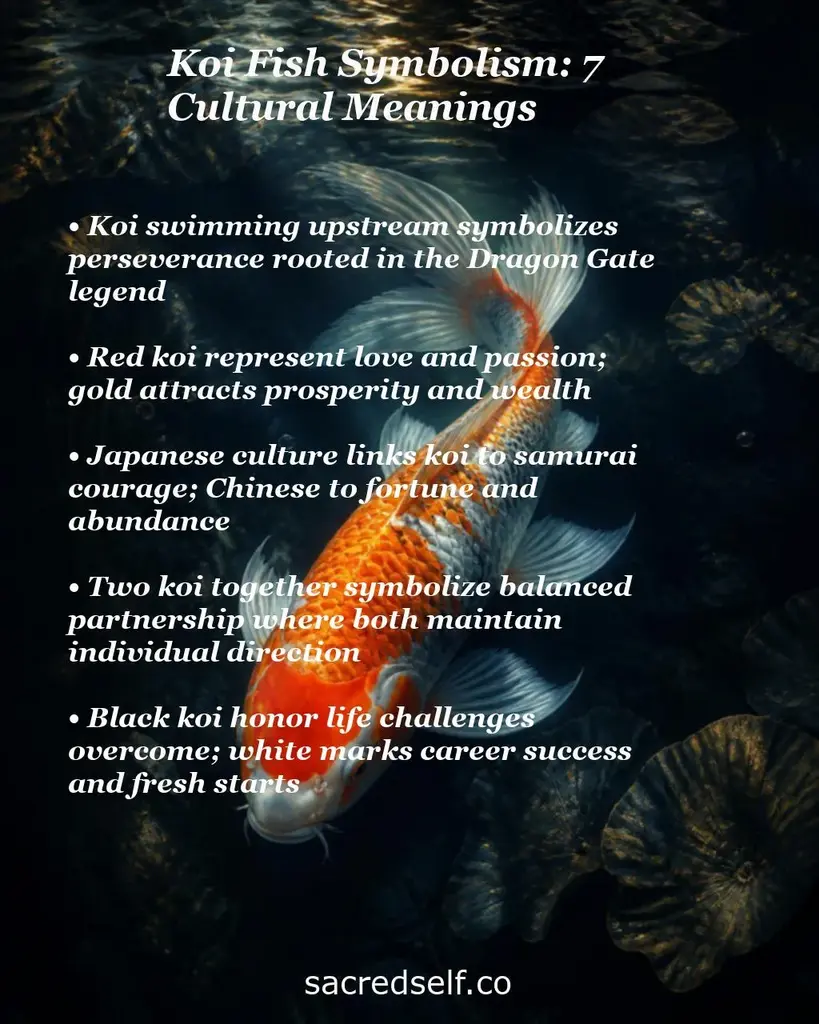
Koi symbolism branches into multiple interpretations depending on color, direction, cultural context, and what you’re facing in your own life. These seven meanings form the core of what koi have come to represent across traditions.
1. Perseverance and Overcoming Obstacles
Koi are known for swimming upstream against strong currents, representing determination and resilience when facing difficulty. This isn’t about a single heroic effort: it’s about sustained movement forward even when progress feels slow.
The interpretation is rooted in the Dragon Gate legend: the koi that successfully climbs the waterfall transforms into a dragon. The journey itself is the point, not just the destination.
This resonates most when you’re facing a difficult situation that requires long-term effort: career challenges, health journeys, or goals that demand consistency over months or years.
What challenge in your life right now requires you to keep moving forward, even when progress feels slow?
2. Transformation and Personal Growth
The metamorphosis from koi to dragon represents profound change: not just improvement, but becoming something fundamentally different. This isn’t surface-level adjustment; it’s about internal shifts in identity, perspective, or life direction.
The legend teaches that by the time the koi reaches the top of the waterfall, it’s no longer the same fish that began the journey. The struggle itself changes you.
This meaning surfaces most during major life transitions: career changes, ending relationships, relocating, or spiritual awakenings where you’re leaving one version of yourself behind.
What version of yourself are you leaving behind? What are you becoming?
3. Strength and Courage
Koi can live for decades, some over 100 years, and thrive in various conditions, symbolizing endurance and adaptability. In Japanese culture, they’re associated with samurai values: facing adversity with composure and dignity.
This is about inner strength and the courage to keep going when quitting would be easier. It’s not raw power or aggression.
This resonates when you need to find your backbone, stand up for yourself, or face something you’ve been avoiding. It’s about showing up even when you don’t feel ready.
Where in your life are you being called to be braver than you feel?
4. Good Fortune and Prosperity
In Chinese symbolism and feng shui, koi attract wealth, abundance, and positive energy. But prosperity doesn’t just mean money: it can represent abundance in relationships, opportunities, creativity, or well-being.
Gold and yellow koi are particularly associated with wealth; red with success. The idea is that koi create flow, breaking through stagnation to allow new things to enter your life.
This meaning becomes relevant when starting a new venture, hoping for a breakthrough, or wanting to shift your relationship with abundance.
What does prosperity actually mean to you beyond money? Where do you already have abundance that you might not be acknowledging?
5. Love, Partnership, and Harmony
Two koi swimming together, often in a circular pattern with one moving up and one down, symbolize partnership and balance. They represent complementary energies, mutual support, and yin and yang dynamics.
This can relate to romantic relationships, close friendships, or internal balance between different parts of yourself. The koi maintain their individual identities while moving together.
This symbol speaks most clearly when you’re in a committed relationship, seeking partnership, or working on balancing opposing forces in your life.
What does balanced partnership look like to you? Are you giving and receiving in equal measure?
6. Patience and Timing
Koi don’t rush. They move with deliberate grace and can wait for the right conditions. In Japanese gardens, watching koi is a meditative practice: they teach us to slow down and be present.
This symbolizes trusting the process and understanding that some things can’t be forced. Growth has its own timeline, and your job is to keep showing up rather than controlling outcomes.
This resonates when you’re feeling impatient with progress, wanting immediate results, or struggling with things outside your control.
What in your life needs more time than you’re willing to give it? What would change if you trusted the timing?
7. Independence and Swimming Against the Current
Koi don’t follow the easiest path. They choose their own direction even when it’s harder, symbolizing non-conformity, trusting your own path, and having the strength to go against prevailing opinions or expectations.
This is different from rebellion for its own sake. It’s about authentic choice: knowing what’s right for you even when others don’t understand or approve.
This meaning emerges when you’re making an unconventional life choice, leaving a path others expected you to follow, or defining success on your own terms.
Where are you following the current because it’s easier, not because it’s right for you?
The Legend of the Koi Fish and the Dragon Gate
The Dragon Gate legend is the origin point for most koi symbolism around perseverance and transformation. Understanding this story explains why a fish has come to represent so much about human struggle and achievement.
In Chinese mythology, a school of koi swim upstream in the Yellow River, facing increasingly strong currents and obstacles. Most turn back when the journey becomes too difficult. The few that persist reach a waterfall at a place called Dragon Gate.
Climbing the waterfall requires extraordinary effort. Most koi still turn back at this point. But the koi that refuses to quit, that keeps swimming upward despite exhaustion and seemingly impossible conditions, finally reaches the top.
As a reward for its perseverance, the koi is transformed into a powerful dragon.
The legend teaches that success comes not from innate talent or luck, but from persistence through difficulty. The koi that becomes a dragon isn’t special at the start: it becomes special through what it endures and refuses to give up on.
There’s another layer here: by the time the koi reaches the top of the waterfall, it’s not the same creature that began the journey. The struggle itself has changed it. Transformation isn’t just the reward: it’s what happens along the way.
This is why koi symbolism resonates so deeply with people facing long-term challenges. The Dragon Gate isn’t a specific destination. It’s whatever waterfall you’re currently climbing, and the dragon is who you’re becoming through the climb.
Koi Fish Color Meanings
Color adds another layer to koi symbolism. Each shade carries specific associations, particularly in Japanese koi breeding traditions and feng shui practices.
Red (Kohaku) Koi
Red koi symbolize love, passion, strength, and bravery. In Japanese culture, red koi are often associated with motherhood and strong feminine energy: fierce, protective, and nurturing at once. This color resonates most in matters of the heart, passionate pursuits, or when you need to tap into protective energy for yourself or others.
Gold or Yellow (Yamabuki) Koi
Gold and yellow koi represent wealth, prosperity, and good fortune. This is the most common color used in feng shui for attracting abundance.
Choose this color when focusing on new business ventures, career advancement, or shifting your mindset around money and what you deserve to receive.
Black (Karasu) Koi
Black koi symbolize overcoming adversity, life challenges, and transformation through difficulty. They often represent the father figure or masculine energy in traditional interpretations.
This isn’t a negative omen. Black koi acknowledge that growth often comes through struggle: they honor the hard parts of your story that shaped who you are.
This color speaks to people moving through particularly difficult periods or honoring how past challenges shaped them into who they are now.
White (Platinum Ogon) Koi
White koi represent success in career, purity of purpose, and new beginnings. They can also symbolize transitions and clean slates: starting fresh with clarity.
This resonates when you’re beginning something new, needing clarity of focus, or working toward specific professional goals.
Blue Koi
Blue koi symbolize tranquility, masculinity in some traditions, and reproduction or fertility. They’re associated with calmness and serenity: the ability to remain peaceful even in turbulent conditions.
This color helps when you’re seeking peace, working through anxiety, or focusing on family planning.
🦋 Readers often explore this next: Spiritual Meaning Of Water
What Does Two Koi Fish Together Mean?
Two koi together, one of the most popular images in both art and tattoos, carry specific meaning about partnership and balance.
The most common interpretation is romantic love and marital harmony. Two koi swimming together represent partners supporting each other through life’s currents, maintaining balance while moving through challenges.
They’re often depicted swimming in opposite directions in a circular pattern. This represents balance between complementary forces: yin and yang, giving and receiving, action and rest. The partners move in different directions but stay connected, supporting each other’s individual paths while maintaining the relationship.
In feng shui, two koi attract harmonious relationships and balance masculine and feminine energies. Placing images or sculptures of paired koi in the relationship corner of your home (southwest area) is believed to support partnership.
But this symbol isn’t limited to romance. It can represent close friendship, business partnerships, or even balance between different aspects of yourself: your practical side and your creative side, your need for connection and your need for solitude.
If you’re drawn to the image of two koi, consider what kind of balance or partnership you’re seeking or honoring. What complementary forces in your life need to work together rather than compete?
Koi Fish Symbolism in Different Cultures
Koi symbolism varies depending on cultural context. The core themes overlap, but the emphasis shifts between traditions.
Japanese Meaning and Tradition
The word “koi” comes from the Japanese word for carp: nishikigoi means “brocaded carp,” referring to their ornamental patterns.
Koi symbolism in Japan is deeply connected to samurai culture and values. The Boys’ Day festival, now called Children’s Day and celebrated on May 5th, features koi flags called koinobori. Families fly these flags representing hopes for their sons to be strong, courageous, and successful through effort rather than luck.
Japanese koi symbolism emphasizes courage, strength, perseverance, and achieving goals through sustained effort. There’s a focus on character development: becoming a person of integrity and resilience.
Koi in Japanese gardens represent tranquility, meditation, and connection to nature. Watching them move becomes a practice in presence and patience.
Historically, Japan refined koi breeding in the 1800s, transforming them from a food source into living art. This cultural investment in beauty, patience, and careful cultivation mirrors the symbolic meanings koi came to carry.
Chinese Symbolism and Feng Shui
Koi fish originated in China and were brought to Japan around 500 BC. The Dragon Gate legend comes from Chinese mythology, specifically the Yellow River.
In Chinese culture, koi primarily symbolize abundance, prosperity, and good luck. The emphasis is on attracting positive energy and material success.
Feng shui applications are specific: koi ponds or images are placed in the wealth corner (southeast area) or career area (north) of homes and businesses. The movement of koi is believed to activate chi, life force energy, and create flow that breaks through stagnation.
A classic feng shui arrangement uses eight red or gold koi plus one black koi. The eight bring prosperity and good fortune; the single black koi absorbs negative energy and provides protection.
The pairing of koi also connects to yin and yang philosophy: two koi represent balance between opposing forces that together create wholeness.
While Japanese tradition emphasizes the character-building aspects of koi symbolism, Chinese tradition leans toward prosperity and energetic flow.
Buddhist Symbolism
Koi appear in Buddhist symbolism as representations of courage to face the ocean of suffering, fearlessness in the face of death, and spiritual awakening.
The upstream journey becomes a metaphor for swimming against the current of desires and attachments: choosing the harder path of spiritual practice over the easier path of worldly comfort.
Reaching the top of the waterfall can represent enlightenment: the transformation that comes from persistent practice and refusing to be swept away by the currents of habitual patterns.
This interpretation aligns with Buddhist teachings about perseverance, though it’s not found in Buddhist scripture itself.
Koi Fish as Spirit Animal or Totem
If koi appears as your spirit animal, you’re being called to persevere through a challenging time with patience and trust in the process.
Core qualities of koi energy include determination, adaptability, finding strength you didn’t know you had, and understanding that struggle itself transforms you. This isn’t about one dramatic breakthrough: it’s about showing up consistently over time.
Koi energy is most helpful during long-term projects, recovery journeys, or when facing repeated setbacks. When immediate solutions aren’t available and you need the stamina to keep going.
To work with this energy, focus on consistent small steps rather than immediate results. Trust that the struggle itself is changing you, building capacity and resilience you’ll need for what comes next.
Track small progress. Koi don’t leap up waterfalls: they swim steadily, gaining ground gradually. Notice the small movements forward even when the top still seems far away.
What waterfall are you currently trying to climb? What would it mean to keep swimming even when you can’t see the top yet?
Koi Fish Tattoo Symbolism
Koi are among the most popular tattoo subjects worldwide, combining rich symbolism with visual beauty and the ability to create striking large-scale designs.
People most commonly choose koi tattoos to mark personal transformation, honor perseverance through hardship, represent life goals they’re committed to achieving, or commemorate important relationships.
Direction matters in traditional interpretation. A koi swimming upstream represents currently struggling or overcoming obstacles: you’re in the middle of your climb. A koi swimming downstream represents having already overcome the obstacle or challenge: you’ve reached your Dragon Gate and transformed.
Color choice adds specific meaning. People select red for love and relationships, gold for prosperity and career success, black for hardships they’ve overcome or are honoring as part of their story, white for new beginnings, or blue for peace and tranquility.
Placement often matters because koi designs benefit from space to show movement. They’re frequently done as larger pieces on the back, thigh, or full arm where the fish can be depicted in flowing, dynamic poses.
Traditional Japanese-style koi tattoos often include water, waves, lotus flowers, or cherry blossoms: each adding layers of meaning about life’s impermanence, beauty, and flow.
Ultimately, personal meaning matters most. Traditional symbolism provides a starting point and cultural context, but your tattoo means what you decide it means based on what you’re carrying, honoring, or committing to.
What Should I Do If I Feel Drawn to Koi Symbolism?
If koi symbolism resonates with you, spend some time exploring what specifically is calling your attention.
Reflective Questions to Explore:
- What specifically about koi fish speaks to you right now? The perseverance? The transformation? The patience? The courage to swim against the current?
- Are you in the middle of your own upstream journey? What waterfall are you climbing?
- What obstacle in your life requires sustained effort rather than a single heroic push?
- If you imagine yourself as the koi in the legend, where are you in the journey? Still in the river? Facing the waterfall? Climbing it? Already transformed?
- What would it mean to trust that the struggle itself is making you stronger?
Practical Steps:
- Create a visual reminder: If the symbolism speaks to you, consider koi imagery in your space: art on your wall, a phone background, or a small sculpture. Let it serve as an anchor during difficult times, reminding you to keep swimming.
- Journal the journey: Document your progress through current challenges. Small wins matter and show you’re still moving forward. On hard days, look back at how far you’ve already come.
- Practice patience: If you’re drawn to koi energy, you might need to slow down and trust timing rather than forcing outcomes. Notice where you’re rushing and experiment with allowing things to unfold.
- Honor your resilience: Reflect on past obstacles you’ve overcome. You’ve already climbed waterfalls before: this isn’t your first time showing up when things were hard.
- Connect with the symbol directly: If possible, visit a koi pond. Watching them move can be meditative and grounding. Notice how they don’t fight the water: they work with it.
Frequently Asked Questions
What do koi fish mean spiritually?
Spiritually, koi fish represent perseverance, transformation, and the strength to overcome life’s obstacles. The core symbolism comes from the Dragon Gate legend: koi swimming upstream and transforming into dragons, representing how sustained effort through difficulty leads to profound personal change.
They’re also associated with good fortune, patience, balance, and courage across various spiritual traditions. The meaning that matters most is the one that resonates with what you’re currently moving through.
What does 2 koi fish mean?
Two koi fish typically symbolize partnership, harmony, and balance, especially in romantic relationships. They’re often shown swimming in opposite directions in a circular pattern, representing complementary energies supporting each other: like yin and yang.
This can apply to romantic partnerships, close friendships, business relationships, or even balance between different aspects of yourself. The key is that both maintain their individual direction while staying connected and balanced.
What color of koi is lucky?
Gold and yellow koi are traditionally considered luckiest for attracting wealth and prosperity, especially in feng shui practices. Red koi are lucky for love and relationships.
But “lucky” depends on what you’re seeking. Black koi represent overcoming adversity. White koi symbolize career success. Blue koi bring tranquility. Choose the color that matches what you need in your life right now rather than a one-size-fits-all version of luck.
What is the rarest color of koi?
The rarest koi colors are typically highly patterned varieties with specific genetic combinations, such as true blue or purple tones, or perfectly symmetrical patterns in certain varieties like Kohaku or Sanke.
However, rarity in koi breeding doesn’t necessarily correlate with symbolic meaning. The symbolism connects to color interpretation and cultural tradition rather than genetic rarity.
Are koi fish mentioned in the Bible?
No, koi fish are not specifically mentioned in the Bible. Koi symbolism originates from East Asian cultures: primarily Chinese and Japanese traditions.
The Bible does reference fish symbolically: Jesus as fisher of men, the loaves and fishes, Jonah and the great fish. But these are different species and contexts from koi symbolism, which developed independently in Eastern philosophical and spiritual traditions.
What does a koi fish tattoo symbolize?
A koi fish tattoo typically symbolizes personal transformation, perseverance through hardship, or achieving difficult goals. Many people choose koi tattoos to mark significant life challenges they’ve overcome or are currently facing.
Direction adds meaning: upstream represents actively struggling through obstacles; downstream represents having overcome them. Color choice adds specificity: red for love, gold for prosperity, black for hardship overcome, white for new beginnings.
Your tattoo means what you decide it means based on what you’re honoring or committing to.
What do koi fish represent in relationships?
In relationships, koi, especially two koi together, represent partnership, harmony, mutual support, and balance. They symbolize two people supporting each other through life’s challenges while maintaining their individual identities.
The circular swimming pattern of paired koi represents how partners can move in different directions while staying connected and balanced. It’s about complementary energies working together rather than one person sacrificing their path for the other.
What’s the difference between Chinese and Japanese koi symbolism?
Chinese koi symbolism emphasizes prosperity, abundance, good fortune, and the Dragon Gate legend of transformation through perseverance. The focus is on attracting positive energy and material success, especially in feng shui applications.
Japanese symbolism focuses more on samurai values: courage, strength, patience, and dignity through adversity. The emphasis is on character development and becoming a person of integrity through sustained effort.
Both share core themes of perseverance and overcoming obstacles, but Chinese tradition leans toward abundance while Japanese tradition emphasizes the internal qualities built through struggle.
Final Thoughts
Koi fish have carried meaning across cultures for centuries because they represent something universal: the challenge of moving forward when conditions are difficult, and the transformation that comes from refusing to give up.
Whether you’re drawn to their symbolism because of a specific challenge you’re facing, a transition you’re moving through, or simply their beauty and grace, the interpretation that matters most is yours. The traditional meanings provide a framework, but you decide what resonates based on where you are right now.
What waterfall are you swimming toward? What might you become by the time you reach it? These aren’t just abstract questions: they point to the specific challenges and transformations happening in your life right now.
If koi symbolism resonates with you, share your experience in the comments: what meaning do they hold in your life, or what challenge are you persevering through right now?
Namaste. 🙏