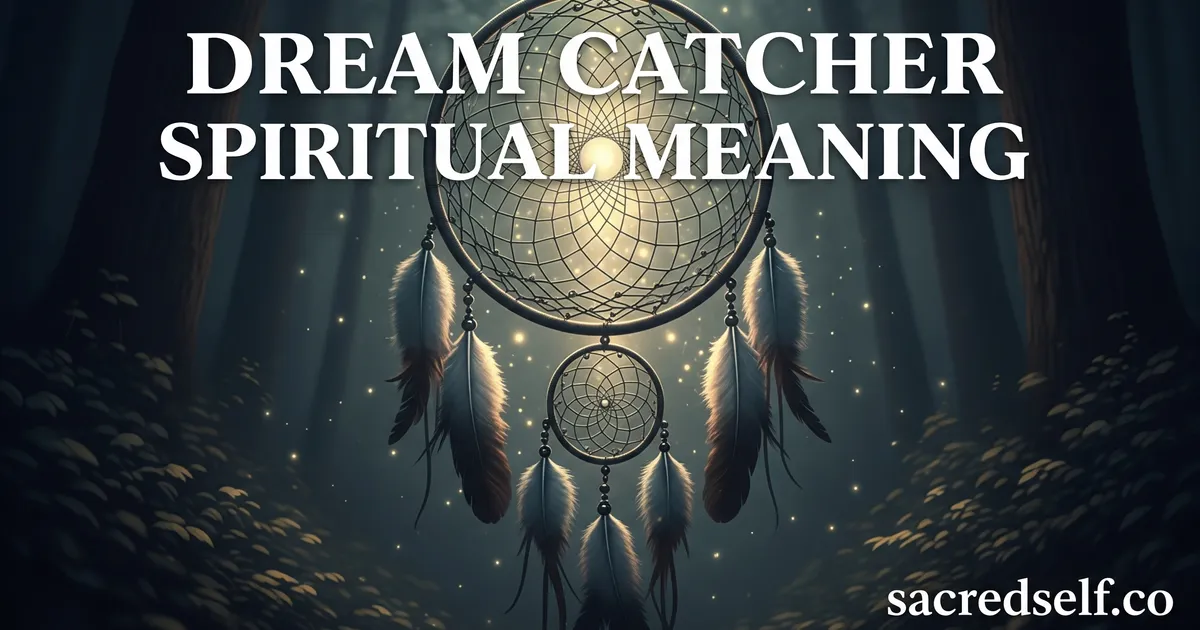
Dream catchers hold one of the most visible spiritual symbols in modern culture: a woven web inside a circle, adorned with feathers and beads. But their meaning runs deeper than decoration. These objects began as sacred protection in Ojibwe tradition, designed to guard children from nightmares and negative energy while they slept.
Today, dream catchers appear in homes around the world. Maybe you received one as a gift, saw one hanging in a shop window and felt drawn to it, or you’re wondering what it actually means to hang one above your bed. The question isn’t just about aesthetics, it’s about understanding what you’re inviting into your space.
Key Takeaways
- Dream catchers originated in Ojibwe (Anishinaabe) culture as protective talismans for children
- The web design catches negative dreams; the center hole allows positive ones to pass through
- Each element carries symbolic meaning: the circle represents life cycles, feathers symbolize breath and air, beads mark caught dreams
- They create protection during vulnerable hours – sleep is when we’re most open and defenseless
- Cultural respect matters: These are sacred objects with specific ceremonial purpose, not just decorative items
- Personal meaning can coexist with traditional significance when approached with awareness and respect
🦋 Readers who enjoyed this also read: Spiritual Meaning Of A Sunflower
7 Spiritual Meanings of Dream Catchers
1. Protection During Vulnerable Hours
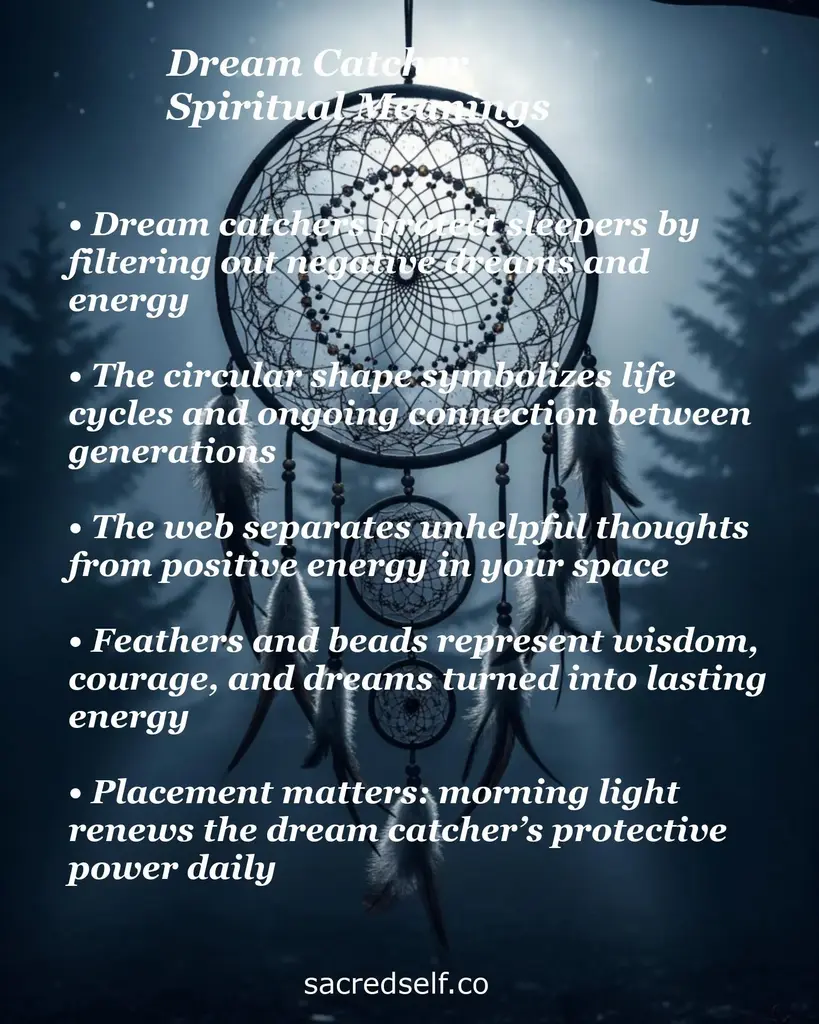
Dream catchers were traditionally placed above sleeping areas to guard against nightmares and negative energy. The web acts as a filter, catching harmful dreams before they reach the sleeper.
This symbolizes creating safe space during sleep – when we’re most open and defenseless. Your conscious mind rests, your body repairs itself, and your subconscious processes the day. Protection during these hours isn’t just spiritual, it’s practical.
If you’re experiencing restless sleep or feeling unprotected, a dream catcher points to the need for emotional boundaries and safe rest. Consider what you’re allowing into your mind before sleep that doesn’t belong there.
2. Connection to Ancestral Wisdom
The dream catcher is rooted in Ojibwe legend about Asibikaashi (Spider Woman) who cared for the children of the nation. As the Ojibwe people spread across North America, mothers and grandmothers created hoops with woven webs to continue this protection when Spider Woman couldn’t reach every cradle.
This represents the continuation of protective care passed down through generations. The circular shape symbolizes the cycle of life and the interconnectedness of all beings: what one generation learns, the next carries forward.
Consider what ancestral wisdom or protective traditions exist in your own lineage. How do you honor those? What has been passed down to you – not just objects, but ways of caring, rituals of protection, beliefs about safety and rest?
3. Filtering Energy and Intention
The web catches what doesn’t serve you. The center hole allows beneficial energy through. This is discernment in physical form – learning what to hold onto and what to release.
A dream catcher acts as a physical reminder to be selective about the energy you invite into your space. Not every thought deserves your attention. Not every worry should follow you to bed. Not every influence belongs in your most vulnerable hours.
What thoughts, relationships, or habits might need filtering in your life right now? Where do you need better boundaries? The dream catcher asks: What are you catching that should dissolve with daylight?
4. Sacred Geometry and Cycles
Dream catchers carry a rich connection to natural cycles. The circle represents the sun’s path across the sky, the cycle of seasons, and wholeness itself. Made traditionally from willow, which bends without breaking, it represents flexibility and resilience.
The web’s pattern reflects natural structures found in spider webs and elsewhere in nature. The number of web points carries meaning: 8 points represent spider’s legs, 13 represent lunar months. Each design choice ties the object to natural cycles and sacred geometry.
Where in your life do you need to honor natural cycles instead of forcing linear progress? Where are you pushing through when you should be allowing things to unfold? The circle reminds you energy moves in cycles, not straight lines.
5. Connection to Nature and Animal Wisdom
Feathers represent breath, the air element, and connection to birds – often owl or eagle in traditional designs. Owl feathers bring wisdom and night vision, the ability to see what’s hidden in darkness. Eagle feathers carry courage and connection to the divine, representing masculine energy and spiritual protection.
Spider wisdom teaches patience, creativity, and weaving your own reality. The spider doesn’t rush – it builds its web with intention, knowing exactly what it’s creating and why.
Natural materials ground the object in earth energy and seasonal awareness. What aspects of your life feel disconnected from natural rhythms? How might you reintegrate them? The dream catcher points you back to patterns older than human schedules.
6. Guidance Through Dreams and the Subconscious
In Ojibwe tradition, dreams are messages from the spirit world or deeper self. The dream catcher acts as a gatekeeper, helping you work with dream wisdom rather than being overwhelmed by nightmares or mental noise.
It encourages paying attention to nighttime experiences and their meanings. What surfaces when your conscious mind steps aside? What are you processing, releasing, or receiving guidance about?
Are you dismissing your dreams or nighttime thoughts? What might they be telling you about your waking life? Sometimes the answer you search for during the day appears clearly at night – if you pay attention.
7. Conscious Intention-Setting in Your Space
Placing a dream catcher is an intentional act of claiming your space. This isn’t passive hoping, it’s active participation in your wellbeing. The object becomes a focal point for your protective intentions.
Every time you see it, you’re reminded of what you decided about your space. You declared: This is a place of rest. This is a place where only beneficial energy is welcome. This is a place where I am safe.
What intention would you set for your sleeping space? What energy do you want to invite or release? The dream catcher holds your answer visible, a daily reminder of the boundaries you’ve chosen.
Cultural & Spiritual Perspectives
Understanding the origins of dream catchers matters. These aren’t generic spiritual tools – they come from specific traditions with specific sacred purposes.
Ojibwe (Anishinaabe) Tradition
The origin story centers on Asibikaashi (Spider Woman), who wove webs over cradle boards to protect children. As the Ojibwe nation spread across North America, mothers and grandmothers created hoops with woven webs to continue this protection.
Traditional materials include willow hoop, sinew or plant fiber, and sacred items like feathers. Dream catchers were made specifically for infants and young children – a protective talisman during their most vulnerable years.
What became a popular decorative item is actually a sacred object with a specific ceremonial purpose. Understanding this context matters when you decide how to bring one into your home.
Lakota Tradition
The Lakota have a different origin story tied to a spiritual leader’s vision about life’s cycles. Here, the web’s center is the path where good ideas and dreams pass through.
The web catches bad ideas, which perish with the first light of day. This version focuses on discernment and wisdom – filtering thoughts and guidance rather than just protecting from nightmares.
Pan-Indian Movement
Dream catchers spread across many Native American nations during the 1960s-70s through cultural sharing and tribal connection. This happened amid Indigenous rights activism when Native peoples reclaimed and shared spiritual practices.
This spread helped preserve Indigenous spirituality but also opened the door to commercialization that strips sacred context from the objects.
Non-Native Adoption and Cultural Respect
Dream catchers entered mainstream Western culture in the 1990s as decorative and spiritual items. They’re often mass-produced with synthetic materials and little connection to their origins.
The important distinction is appreciation versus appropriation. Appreciation means learning the actual traditions, understanding the sacred context, and purchasing from Native artists when possible. Appropriation means adopting the aesthetic while ignoring or dismissing its cultural significance.
If you’re drawn to dream catchers, ask: Are you willing to learn where they come from? Will you support Native artists rather than buying mass-produced versions? Do you understand this is a sacred object, not just decoration?
Biblical and Christian Perspectives
Dream catchers don’t appear in biblical texts – they’re Indigenous to North America and developed long after the Bible was written. This leads to varying responses in Christian communities.
Some Christians use them as tools for prayer and protection, similar to crosses or rosaries, seeing them as physical symbols that focus intention and create sacred space.
Others avoid them, concerned about engaging with spiritual practices outside their tradition or worried about syncretism – mixing different religious practices in ways that dilute faith.
This is a personal choice. Does it align with your faith, or conflict with it? Does it help your spiritual practice or create internal conflict? There’s no single Christian answer.
🦋 Our readers also explored: Spiritual Meaning Of Bumble Bees Flying Around You
How Dream Catcher Elements Carry Meaning
Each part of a dream catcher serves a purpose. Understanding these helps you appreciate the intention woven into the design.
The Hoop/Circle
The circle represents the circle of life, unity, and strength. It’s an unbroken line with no beginning or end, symbolizing the eternal nature of energy and wholeness.
Traditionally made from willow, which bends without breaking, the hoop means flexibility and resilience. Life tests you, bends you, puts pressure on you – but like willow, you don’t have to break.
The Web/Net
Patterns vary but traditionally feature 8 points (spider’s legs) or 13 points (lunar cycles). The weaving is meditative and intentional – each crossing deliberate.
The web catches what doesn’t serve the sleeper until it dissolves with daylight. Morning sun burns away caught nightmares, renewing the dream catcher’s protective power.
Feathers
Feathers represent air, breath, and moving between realms. They let good dreams slide gently to the sleeper, like breath or wind.
Owl feathers symbolize wisdom, night vision, and seeing what’s hidden – fitting for an object working during darkness. Eagle feathers stand for courage, divine connection, and masculine protective energy. The feather type carries intention.
Beads and Decorations
Beads can represent caught good dreams that became permanent, like crystals forming from beneficial energy in the web. The number of beads may carry meaning depending on maker and tradition.
Additional gemstones bring their own energies: amethyst for peaceful sleep, clear quartz for clarity, turquoise for protection. Each adds layers of meaning.
Where and How to Use a Dream Catcher
Placement and use matter. A dream catcher isn’t just decoration to hang anywhere. It has traditional guidance on where and how to display it.
Traditional Placement
Above or near the bed where morning light can hit it. This placement serves two purposes: protecting the sleeper at night and letting sunlight burn away caught negative dreams each day, renewing its power.
Originally meant for children’s sleeping areas, dream catchers protected the most vulnerable during their most vulnerable hours.
In Your Home
The bedroom remains the most traditional placement for dream protection. Some place dream catchers elsewhere as reminders of intention.
Consider window placement where light and air reach it. The dream catcher needs renewal – stagnant placement in a dark corner doesn’t honor its purpose.
Avoid treating it as pure decoration. Don’t hang it in the bathroom, leave it on the floor, or use it as a car accessory. Intention matters. If you have one, respect what it represents.
Respectful Use
If you didn’t make it yourself, know who did. Support Native artists when possible – this ensures the object was made with cultural understanding and your money goes to Indigenous communities.
Understand it’s more than aesthetic; it carries cultural and spiritual weight. Set an intention when you first hang it. What do you want it to do in your space? What protection are you asking for?
Different Types and Their Meanings
Traditional designs use natural materials and follow patterns passed down through generations. Contemporary designs may add new materials while honoring symbolism.
Size variations: Smaller dream catchers for personal and intimate spaces. Larger ones protect shared or communal spaces.
Color symbolism: White means purity and light. Red means vitality and life force. Black offers protection and grounding. Natural colors maintain earth connection and respect traditional materials.
Materials matter. Authentic materials (willow, sinew, natural feathers) carry different energy than synthetic ones. Both can be meaningful, but they’re not the same.
🦋 You might also be interested in: Stacking Rocks Spiritual Meaning
Practical Reflection: What Does This Mean for You?
Theory only goes so far. The real question is what dream catchers mean in your life, in your space, with your intentions.
Questions to Consider
- What drew you to dream catchers? Visual appeal, a gift, or something deeper calling your attention?
- Do you need protection in your sleeping space? Are you experiencing restless sleep, nightmares, or a bedroom that doesn’t feel safe?
- What does “filtering dreams” mean in your life now? Where do you need better discernment about what to let in or release?
- Where do you need better boundaries? The dream catcher’s web catches what doesn’t serve you. What in your waking life needs that filter?
Personal Integration Steps
- If you have a dream catcher: Ask what intention you want it to hold in your space. Don’t just let it hang – make it meaningful.
- If you’re considering one: Reflect if you’re drawn to its cultural significance or just the look. If just aesthetic, choose different decor. If meaning, honor that with learning and respectful purchase.
- Research Native artists and craftspeople through sites like Beyond Buckskin, Native Art Market, or tribal cooperatives to find authentic pieces.
- Start a dream journal to notice patterns, symbols, and how you feel on waking.
- Consider your boundaries: What mental or emotional filters do you need in your waking life? The dream catcher’s lesson applies beyond sleep.
- Examine your sleeping space: Does it feel safe and restful? If not, what changes would help – dream catcher or not?
When It Resonates
You may be dealing with themes of protection, boundaries, or discernment. The dream catcher’s symbolism addresses these directly.
You want tangible ways to work with spiritual concepts.
Sleep or dream issues – restlessness, vivid dreams, nightmares, or feeling unprotected – point to the dream catcher’s original purpose.
You’re seeking physical ways to set intentions. A dream catcher offers a focal point and reminder of your chosen boundaries.
When to Reconsider
- If you only see it as decoration, reconsider. There are many beautiful decorative items without sacred cultural weight.
- If it conflicts with your spiritual or religious practice, respect that. Tools should support your practice, not create internal conflict.
- If you’re unwilling to learn and respect its origins, don’t use one. That’s appropriation and disrespects Ojibwe creators.
Frequently Asked Questions
What do dream catchers symbolize spiritually?
Dream catchers symbolize protection during sleep, filtering negative energy, and connection to ancestral wisdom. The web catches nightmares and harmful energy while allowing good dreams through. The circle stands for life’s interconnectedness and eternal cycles. They represent the bridge between physical and spiritual worlds, helping you work with dream messages instead of getting overwhelmed.
What is the rule for the dream catcher?
Traditionally, dream catchers should hang above the sleeping area where morning light reaches them. Sunlight burns away trapped negative dreams daily, renewing the dream catcher’s power. They are sacred objects, not just decorations. Some traditions reserve them for children, others for anyone needing dream protection. The key is intentional placement and respectful use.
Is it OK to have a dream catcher?
Yes, but with respect for their cultural origins. If you’re drawn to dream catchers, learn about their Ojibwe roots and meaning. Buy from Native American artists to support Indigenous communities and avoid mass-produced versions. Make sure having one fits your beliefs and that you’re engaging with it thoughtfully, not as a trend. The difference between appreciation and appropriation is respect and intention.
Do dream catchers protect you?
In Indigenous tradition, dream catchers protect sleepers – especially children – from nightmares and negative energy. Whether they protect depends on your beliefs and intentions. Many feel more peaceful with one in their space. This might come from the object, your intention, or the comfort of a protective symbol. If you believe in its protection, it likely helps you feel safe and calm.
What does the Bible say about dream catchers?
The Bible doesn’t mention dream catchers. They originate from Ojibwe culture in North America long after biblical texts were written. Some Christians use them for prayer and protection, like crosses or rosaries, as physical symbols of intention. Others avoid them, worried about mixing faiths or conflicting beliefs. This is a personal choice based on how it fits your spiritual practice.
What does a dream catcher in your house mean spiritually?
A dream catcher in your home signals an intention to filter energy and create protection, especially during sleep. It reflects your desire for peaceful rest, connection to nature and Indigenous wisdom, and boundaries between positive and negative energy. The meaning depends on your intention – what you want it to do and why you brought it in. It shows you’re actively managing the energy in your space.
What do different types of dream catchers mean?
Dream catcher meanings vary by size, color, design, and materials. Small ones serve personal spaces; large ones protect shared areas. Color symbolism: white for purity, red for vitality, black for protection, natural colors for earth connection. Web points: 8 for spider legs, 13 for lunar cycles. Feathers: owl for wisdom, eagle for courage. Materials: natural (willow, sinew, feathers) carry different energy than synthetic. Traditional materials connect you to earth energy.
What does the 13-point dream catcher mean?
A dream catcher with 13 points represents the 13 phases of the moon or lunar months in a year. This links it to lunar cycles, feminine energy, and natural rhythms of time. It highlights the connection between dreams, nighttime, and the moon’s influence. Choosing a 13-point dream catcher may mean working with lunar energy or aligning with natural cycles rather than forcing progress.
Final Thoughts
Dream catchers carry layers of meaning – from their specific origins in Ojibwe tradition to the personal significance they hold today. The web, the circle, the feathers: each part challenges you to consider what you’re filtering in your life and what you allow through.
Whether you see dream catchers as protective tools, symbolic reminders, or connections to Indigenous wisdom, the key is respecting their origins and being intentional with their presence.
What needs protection in your life right now? How can you be more intentional about the energy in your sleeping space? Set a fresh intention with it today. If you’re thinking of getting one, ask yourself why: is it just for looks or something deeper?
Have you experienced changes in your sleep or dreams after hanging a dream catcher? What drew you to it, and what does it mean in your space? Share your experience in the comments.
Namaste. 🙏
🦋 You may also find insight in: Why Is My Left Foot Itching Spiritual Meaning