
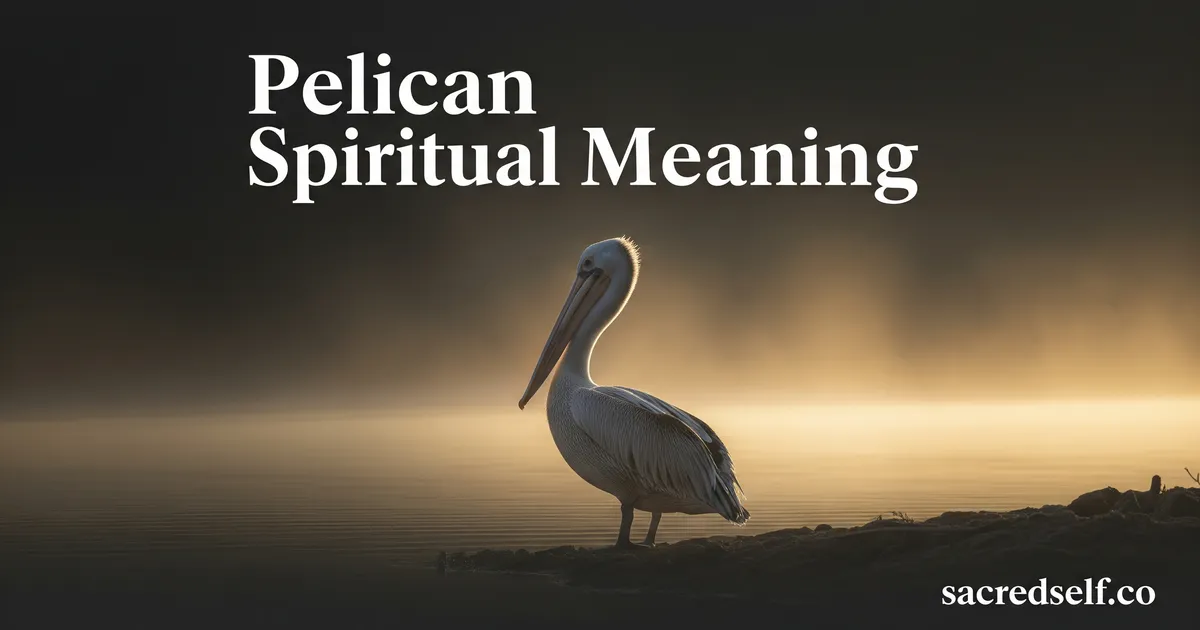
Medieval Christians believed pelicans would pierce their own breasts to feed their young with blood. This image, the pelican-in-her-piety, became one of the most powerful symbols of Christ-like love in Western art and theology. The legend isn’t biologically true, but the symbolism runs deep. Pelicans have been tied to sacrifice, devotion, and spiritual renewal for centuries.
If you’ve recently encountered a pelican – whether in the wild, in a dream, or through unusual circumstances – it likely holds meaning for you. This bird carries deep spiritual significance across cultures, from Christian resurrection to intuitive wisdom about community and abundance.
Key Takeaways
- Self-sacrifice and devotion: The pelican symbolizes giving of yourself for others, often tied to the legend of feeding young with its own blood
- Nurturing and protection: A powerful emblem of maternal energy and fierce care for those you love
- Spiritual renewal and rebirth: Associated with resurrection, fresh starts, and transformation after hardship
- Community cooperation: Pelicans hunt in groups, representing teamwork and collective success
- Patience and divine timing: Their hunting style reflects trust in the process and waiting for the right moment
- Generosity and abundance: The large throat pouch symbolizes capacity to give and receive
- Spiritual cleansing: As water birds, pelicans represent emotional and spiritual purification
🔮 Top picks on Amazon: Best Spiritual Books For Women
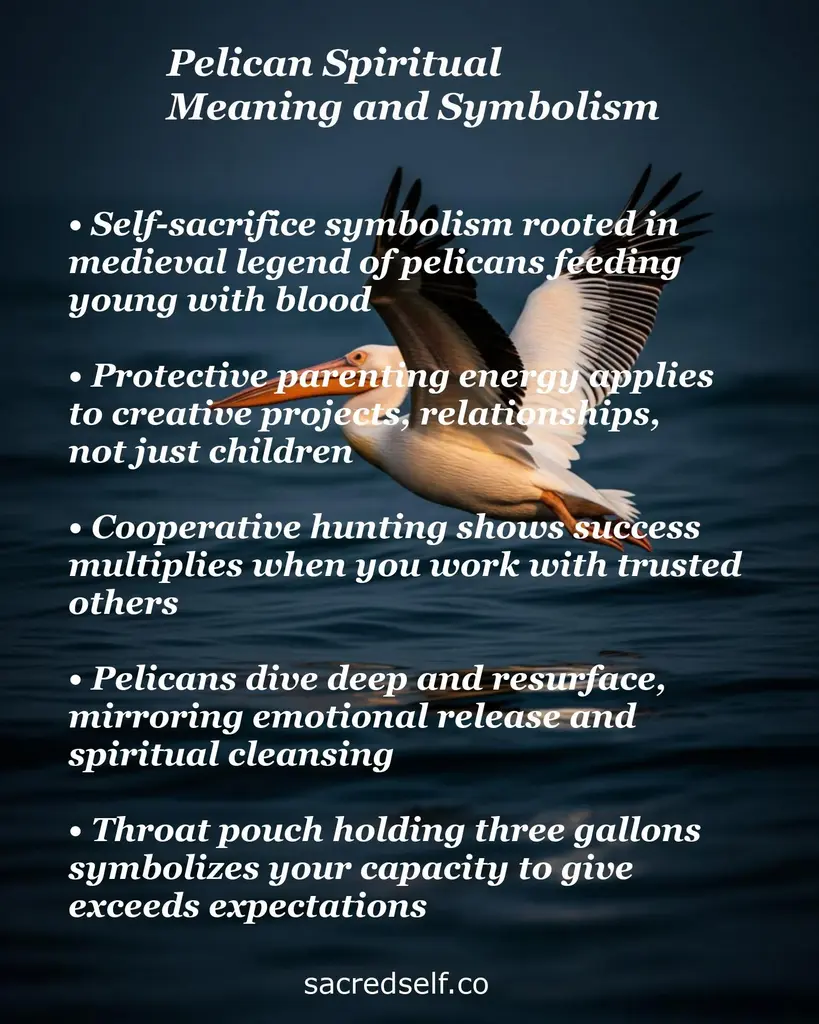
7 Spiritual Meanings of Pelican Symbolism
Pelicans carry multiple layers of spiritual significance. Each meaning reflects a different aspect of this bird’s behavior and historical symbolism.
1. Self-Sacrifice and Devotion
The most enduring pelican symbol comes from medieval legend: the pelican piercing its breast to revive its young with its own blood. While pelicans don’t actually do this, the image became synonymous with selfless love and devotion.
What this means spiritually: You may be in a season of giving deeply to others – family, friends, community. The pelican asks you to examine your motivations. Are you giving from overflow or depletion? True devotion comes from a full heart, not an empty one.
You may see pelican symbolism when you’re being called to step up in service. Others take it as confirmation that their sacrifices matter, even when they feel invisible.
Reflection: Where in your life are you being called to give of yourself? Is your giving sustainable, or are you running on empty?
Practical step: Write down three ways you currently serve others. Next to each, note whether it fills you up or drains you. Adjust accordingly.
2. Nurturing and Maternal Protection
Pelicans are fiercely protective parents. They create safe nesting environments and guard their young with focus and dedication. This makes them powerful symbols of maternal energy and protective instincts – regardless of your gender or parenting status.
If a pelican appears in your life, it may be highlighting your role as a nurturer. This could apply to children, creative projects, new ideas, or relationships that need tending.
What this means spiritually: You’re being reminded to protect what matters most. This isn’t about control – it’s about creating space for growth while maintaining healthy boundaries.
Reflection: What in your life needs your protective energy right now? Are you guarding it well, or have you left it vulnerable?
3. Spiritual Renewal and Resurrection
In Christian symbolism, the pelican became a metaphor for Christ’s sacrifice and resurrection. The bird’s ability to dive deep into water and emerge with sustenance also connects it to cycles of death and rebirth in a spiritual sense.
Seeing a pelican may signal that you’re entering a phase of renewal. Something old is ending. Something new is ready to emerge. The pelican reminds you that transformation often requires a kind of death – the shedding of old identities, beliefs, or patterns.
What this means spiritually: You may be coming out of a difficult period. The pelican’s appearance is a sign that renewal is underway, even if you can’t see the full picture yet.
Practical step: Identify one area of your life that feels stagnant or outdated. What would it look like to let it die so something new can be born?
4. Community Cooperation and Teamwork
Pelicans fish in coordinated groups. They’ll circle schools of fish together, driving them into shallow water where they’re easier to catch. This cooperative hunting strategy is highly effective and requires trust, timing, and communication.
If a pelican shows up in your life, it may be pointing to the power of collaboration. You don’t have to do everything alone. Working with others – when done well – multiplies success.
What this means spiritually: You’re being invited to consider how well you work with others. Are you isolated when you could be collaborating? Are you trying to control outcomes instead of trusting the group process?
Reflection: How well do you balance your individual needs with the needs of a group? Where could you benefit from asking for help or joining forces?
5. Patience and Divine Timing
Pelicans are patient hunters. They float, observe, and wait for the right moment to strike. They don’t rush. They trust the process.
Reminder not to force outcomes. Growth – spiritual, emotional, or practical – happens on its own timeline. The pelican teaches you to trust that what you need will come when the time is right.
What this means spiritually: If you’re feeling impatient or frustrated with how long something is taking, the pelican is here to reassure you. Keep showing up. Keep doing the work. Trust the timing.
Practical step: Identify one area where you’re feeling rushed or anxious. Ask yourself: What would it look like to trust the process here? What can I control, and what do I need to release?
6. Generosity and Abundance
The pelican’s throat pouch can hold up to three gallons of water and fish. It’s a natural symbol of capacity, abundance, and the ability to hold and share resources.
Seeing a pelican may be a sign that you’re entering a season of abundance – not just material, but emotional and spiritual. It also suggests that you have more to give than you think.
What this means spiritually: The pelican reminds you that life provides. You don’t need to hoard or operate from scarcity. There’s enough. You have enough. You are enough.
Reflection: How do you approach giving and receiving? Do you give freely, or do you hold back out of fear? Do you allow yourself to receive, or do you deflect generosity?
7. Spiritual Cleansing and Purification
Pelicans are water birds, and water has long been associated with emotional release, cleansing, and spiritual purification. The pelican dives beneath the surface and emerges renewed, a powerful metaphor for inner work.
If you’re encountering pelican energy, it may be time to release old emotional baggage, limiting beliefs, or patterns that no longer serve you. The pelican invites you to dive deep, face what’s beneath the surface, and come up cleansed.
What this means spiritually: You’re ready to let go of something heavy. This could be grief, resentment, fear, or old stories about who you are. The pelican says: It’s safe to release it now.
Practical step: Set aside time for a cleansing ritual. This could be as simple as a bath with intention, journaling what you’re ready to release, or spending time near water with the conscious goal of letting go.
Cultural and Spiritual Perspectives
Pelican symbolism varies across traditions, but themes of sacrifice, nurturing, and renewal appear consistently.
Christian Symbolism and Medieval Traditions
In early Christian texts like The Physiologus (a 2nd-century Greek bestiary), the pelican was described as a bird that kills its young in anger, mourns them for three days, then pierces its own breast to revive them with its blood. This allegory became a direct parallel to Christ’s death and resurrection.
By the Middle Ages, the pelican-in-her-piety – the image of a pelican feeding her young with her own blood – appeared in religious art, church architecture, and heraldry. It symbolized the Eucharist, Christ’s sacrifice, and selfless love.
Biblical reference: Psalm 102:6 mentions the pelican, though in a different context: “I am like a pelican of the wilderness; I am like an owl of the desert.” Here, the pelican represents isolation and loneliness, a creature dwelling in desolate places. This adds another layer: the pelican also symbolizes solitude, reflection, and the spiritual desert – times when you feel distant from others but close to something deeper.
Spirit Animal and Totem Meanings
In modern spiritual practices, the pelican is considered a spirit animal for nurturing souls, caregivers, and community leaders. If pelican is your totem, you’re likely someone who feels called to serve, protect, and create spaces where others can thrive.
Pelican as a totem also connects you to water element wisdom – emotional intelligence, intuition, and the ability to navigate feelings without drowning in them. People with pelican energy are often empathic, generous, and deeply protective of loved ones.
When pelican appears as a guide, it may be reminding you to balance giving with self-care, to trust your instincts about when to dive deep and when to float, and to recognize that your capacity to help others is a gift – but only if you don’t deplete yourself in the process.
🦋 This might also resonate with you: Turtles Spiritual Meaning
Pelican Encounters and Dream Interpretation
The context of your pelican encounter matters. A pelican in waking life carries different energy than one in a dream, and behavior matters too.
Seeing a pelican in waking life: This often feels like a direct message. If the pelican was feeding, it may point to themes of provision, generosity, or caregiving in your life. If it was flying, it could symbolize perspective – the ability to rise above a situation and see it from a higher vantage point. If the pelican was resting, it might be a reminder to pause, breathe, and trust that you don’t need to be in constant motion.
Location context: A pelican at the beach feels natural, but a pelican inland or in an urban area carries extra significance. It’s out of place, which suggests something unexpected is entering your life – a message, an opportunity, or a shift you didn’t see coming.
Emotional state during the encounter: How did you feel when you saw the pelican? Calm? Curious? Startled? Your emotional response is part of the message. If you felt peace, the pelican may be confirming you’re on the right path. If you felt unsettled, it may be pointing to something you need to address.
Pelican dreams: Dreaming of pelicans often relates to themes of caregiving, sacrifice, and emotional depth. If the pelican is feeding its young, you may be processing your own role as a nurturer or considering whether you’re giving too much. If the pelican is diving, it suggests you’re ready to go deeper emotionally or spiritually. If the pelican is injured or struggling, it may reflect feelings of depletion or concern that you’re not doing enough.
Dreams of flying pelicans often symbolize freedom, perspective, and the ability to rise above challenges. Dreams of dead pelicans can feel heavy, but they often represent the end of a cycle of over-giving or the need to let go of old patterns of self-sacrifice.
What Should I Do After a Pelican Encounter?
A pelican encounter invites reflection. Here’s how to explore what it might mean for you.
Ask yourself these questions:
- What was happening in my life when I saw the pelican?
- What was I thinking or feeling in that moment?
- Am I in a season of giving, receiving, or both?
- Do I feel depleted, or do I feel full?
- Where am I being called to show up more fully?
- Is there something I need to release or renew?
Journaling prompts:
- Write about a time you gave deeply to someone or something. How did it feel? Was it sustainable?
- What does sacrifice mean to you? Is it always noble, or can it become harmful?
- Where in your life do you need more patience right now?
- What are you protecting? Is it worth protecting, or is it time to let it go?
Practical steps for embodying pelican wisdom:
- Practice one act of service this week that feels joyful, not obligatory
- Set a boundary around your time or energy to protect your own well-being
- Spend time near water – a lake, river, or ocean – and reflect on what you’re ready to release
- Reach out to your community. Where could collaboration replace isolation?
If pelicans keep appearing, repeated encounters suggest the message is urgent or hasn’t been fully received. Pay attention to the pattern. What’s consistent across each sighting? What part of your life keeps calling for your attention? Trust that the repetition is intentional.
🦋 Readers often explore this next: Spiritual Meaning Of A Deer In Your Path
Frequently Asked Questions
What does it mean when a pelican crosses your path?
A pelican crossing your path often signals a time of transition. It may be pointing to an upcoming opportunity to serve others, or it may be reminding you to trust your nurturing instincts. If you’re facing a decision about giving your time or energy, the pelican is confirmation that your care matters – but make sure you’re not giving from an empty place.
Are pelicans good or bad omens?
Pelicans are generally seen as positive symbols. They represent devotion, abundance, renewal, and community. Context matters more than superstition. If the pelican felt like a comforting presence, trust that. If it felt unsettling, ask yourself what that discomfort is pointing to. Your personal response is the best guide.
What does the Bible say about pelicans?
The Bible mentions pelicans in Psalm 102:6: “I am like a pelican of the wilderness.” This verse speaks to isolation and loneliness, a contrast to the nurturing symbolism pelicans later took on in Christian tradition. Early Christians interpreted the pelican as a symbol of Christ’s sacrifice, drawing from legends about the bird feeding its young with its own blood. This image became central to medieval Christian art and theology.
What does dreaming of pelicans mean?
Dreaming of pelicans often relates to caregiving, emotional depth, and sacrifice. If the pelican is feeding or protecting its young, you may be processing your own role as a nurturer. If it’s diving, you’re ready to explore deeper emotions or spiritual truths. If the pelican seems injured or struggling, it may reflect feelings of depletion or worry that you’re giving too much. Pay attention to how you felt in the dream – that emotion is part of the message.
Is the pelican a Christ symbol?
Yes. The pelican became one of the most enduring Christian symbols, particularly in medieval Europe. The image of the pelican-in-her-piety – a mother pelican piercing her breast to feed her young with her blood – was seen as a direct parallel to Christ’s sacrifice on the cross. It appeared in church art, stained glass, and religious manuscripts. While the legend isn’t biologically accurate, the symbolism remains powerful in Christian iconography.
What does it mean if pelicans keep appearing?
Repeated pelican encounters suggest the spiritual message is important and hasn’t been fully integrated. Ask yourself: What’s happening in my life right now? Am I ignoring a call to give, serve, or protect? Am I neglecting my own needs while caring for others? The repetition is a signal to pay closer attention. Journal about each encounter and look for patterns in timing, behavior, or your emotional state.
Closing Reflection
The pelican’s spiritual meaning centers on sacrifice, devotion, renewal, and abundance. Whether you see it as a Christ symbol, a totem of nurturing energy, or a reminder to trust divine timing, the pelican asks you to consider how you give, how you receive, and whether you’re caring for yourself as deeply as you care for others.
Reflect: Where are you being called to show up with more devotion or nurturing energy? Where do you need to set a boundary so your giving doesn’t become depletion?
Have you encountered a pelican in a way that felt meaningful? What was happening in your life at the time, and what did it teach you? Share your story in the comments – your experience might be exactly what someone else needs to hear.
Namaste. 🙏
🦋 Continue your journey with: Bull In Dream Spiritual Meaning